So, I'm involved with a really exciting new blog project called "Philosophical Percolations: All The Philosophy That's Not Fit to Print." (just a mock-up so far). It will be a collaborative blog with 10-20 authors (currently we have 13), that will open on May 13th. We plan to have new weird philosophy, for the Internet for free every day. There will be philosophy of professional wrestling. There will be speculative realism. There will be analytics and continentals, thinking together! You know, mass hysteria! It'll be great. We plan to be weird, be diverse, and disagree with each other. We're going to try to keep blatant politics, news of the profession, and anonymous philoso-troll comments to a bare minimum. And no advertising, but lots of pictures to illustrate our points. Jon Cogburn, in particular likes adding old punk & post-punk videos to his posts.
However, it means that I'm going to be writing a lot of philosophy over there rather than over here. I'm not planning to close this blog down, at least short term. I may still throw up a webcomic review or recipe every now and then. But I suspect that from May on, for the rest of 2015, I'll probably post over there a LOT, and over here a very little. I'm hoping to continue to post philosophy, and probably poetry, here for the rest of March and April though. I'll certainly announce it again with far more links, once the other blog actually opens. That concludes our service announcement, carry on folks.
Beyond easy logics; beyond male and female; beyond simple answers like true or false; messy but alive ...
Tuesday, March 24, 2015
Friday, March 20, 2015
Slacktivism and Szymborska
I've had conversations several times
in the last few weeks, with several people about slacktivism, and the
sense that the bar on political activity has become so low, that the
smallest things seem political, and many seem to channel their
political impulses into the smallest of things. For some this is a
dire sign, the trivializing of the important. The decline of real
activism into the merest shade of symbolic action, the laziest of all
possible protests. For others, this is a sign of political activity
adapting to the tastes and communication styles of a new generation,
of a regeneration of political engagement, where being political is
no longer confined to the halls of money and power, but animates
regular people in their daily lives. For others, the politicization
of all things feels like a stifling interference, where ideas from
the humanities attempt to but their nose into the sciences or
business worlds, or other places where they seem sometimes like
intruders.
I have many mixed feeling myself, but
want to defend some kinds and styles of slacktivism, in some
contexts. Last night, at my open night poetry reading, I read one of
my own fumbling poems on the topic, and another reader I'm slowly
getting to know, replied to me with a poem by Wislawa Szymborska. It
was just exactly right. It has gotten me re-thinking.
But before I get to the poem, I need a
brief detour through “political theology.” American
understanding of political theory usually make sense of the
foundations of the modern state in terms of figures like Locke,
Hobbes, Hume and Smith, even Machiavelli, who turned away from
religion and tried to ground things in talk of contracts. But there
is a strain of political theory, especially in Europe, from Carl
Schmitt to Jurgen Habermas and then to living folks like Giorgio
Agemben, Ernesto Laclau, or Paul Kahn (many of them atheists),
exploring the idea that to quote Schmitt “all significant concepts
of the modern theory of the state are secularized theological
concepts.” In this style of seeing, often called “political
theology,” the foundation of the state is not a prior contract, but
a prior act of sacrifice - and the state itself is not an agreement
among equals constantly being re-negotiated as much as it is a sacred
thing inherited from the past providing a framework within which we attempt
to find meaning for our collective activities.
In this style I thinking, I suspect
that slacktivism looks suspiciously like a political analog of what
in theology is called “cheap grace.” (A term and idea coined by
African-America pastor, Rev. Adam Clayton Powell, popularized by
German theologian Dietrich Bonhoffer in his book The Cost of
Discipleship.) “Cheap grace” is the idea of trying to receive
the blessing of sanctity without having undergone the burdens of
authentic discipleship. Even if the grace is freely given, it seems
somehow a poor or immature response to it to take blessing and move
on with one's life, rather than being deeply transformed by it into
someone trying to “live up to it.” Enjoying the benefits of the
past struggles of political activists who toiled hard and in many
cases “sacrificed” for the current imperfect political regime,
and responding in turn with slacker-activism, can feel intuitively
like “desecrating” past sacrifices or real discipleship/activism.
But being authentically political has
to involve, eventually, integrating politics into one's whole life.
Not just how you vote, but how you spend money, how you talk, how you
act in big things and small. But that means that your political
convictions should manifest somehow in even little, easy, trivial,
dayly things. Which hashtags you use, for instance. As always,
someone who does small things well, but screws up the big ones, is
criticizable, and often a hypocrite, and hypocrisy is especially
loathsome when mixed with arrogance or self-righteousness. But I
have a lot of sympathy with a humble hypocrite, who knows they don't
live up to their highest ideals, yet, and is trying and failing to be
better than they are. And that is true for politics, ethics, or
religion. This is one of the reasons that a culture of calling-outneeds to be replaced in most cases with on of calling-in, where
you criticize well-meaning failures privately rather than publicly and thereby risking alienating potential allies to show off your own
self-righteousness. We want to avoid the hypocrisy of taking the
easy way out, and then letting ourselves off the hook, but we also
want to avoid making the perfect the enemy of the good, too. In this
fascinating analysis of fragmentation on the left I'm a moderate on
the suspicion vs solidarity axis.
If slacktivism is all we do to try to
build intentional bridges between ourself and our world, then that is
pretty pathetic. But if it is one aspect of what we do, that is
another story. Similarly, I'm pretty skeptical of my ability to have
real effects on the decisions of the wealthy and the halls of power.
But I have some power at least over my daily life, and the people I
personally interact with. These minimal interactions - trying to be
polite, friendly, and respectful to people; trying to cut people some
slack; trying to gently encourage thought and growth; trying to help
people see the best in themselves; trying to get my own house in
better order; this is where the personal and political meet, and is
the sphere where I feel the least hopeless. And a lot of that
manifests on the internet, because that is where I do most of my
socializing.
OK Szymborska
“Children of the Age”
We are children of our age,
it's a political age.
All day long, all through the night,
All affairs – yours, ours, theirs -
are political affairs.
Whether you like it or not,
your genes have a political past
your skin, a political cast,
your eyes, a political slant.
Whatever you say reverberates,
Whatever you don't say speaks for
itself.
So either way you're talking politics.
Even when you take to the woods,
you're taking political steps
on political grounds.
Apolitical poems are also political,
| Our political moon |
and above us shines a moon
no longer purely lunar.
To be or not to be, that is the
question.
and though it troubles the digestion
it's a question, as always, of
politics.
To acquire a political meaning
you don't even have to be human.
Raw material will do,
or protein feed, or crude oil,
or a conference table whose shape
was quarrel over for months:
Should we arbitrate life and death
at a round table or a square one.
Meanwhile, people perished,
animals died,
houses burned,
and the fields ran wild
just as in times immemorial
and less political.
-by Wislawa Szymborska, translated by
Stanislaw Baranczak and Clare Cavanagh, 1988
All human affairs, and even many
things beyond the immediately human, are political whether we like it
or not. Who we are personally is political, even in our genes and
our past. We don't have to focus on the political aspect of our
experience all the time, thematizing it. Sometimes we can look at
the sunset or do math or sip tea while watching TV. These things are
political too, it's part of the background of their being, but we
don't always have to focus on it. We DO have to admit it to
ourselves, acknowledge that self and world and others are all linked
in various ways whether we like it or not. Politics may feel intrusive in some domains, but it is already there whether we like it or not, it is just a matter of if we can overcome our self-deception enough to face it squarely from time to time. We do have to find ways
to live our lives within this interlinking. We do have to
acknowledge that people are perishing while we arbitrate life and
death, but that this is not new, or unique to us. That there isn't a
quick fix, or cheap grace or slacktivist solution to the conundrums of interconnection. But slacktivism may well be one part of
navigating this terrain well. I still have good hope that there is
room for ourselves to unfold within this space of interconnection,
well, some of ourselves … sigh.
Tuesday, March 17, 2015
Between Street Art and Public Art - let's call it Community Art maybe?
So I'm no expert on Street Art but one
of the very first ideas in the philosophical reflection on Street Art
is that Street Art and Public Art are not the same thing. There was
recently a conference on the philosophy of Street Art, and a
philosopher I like Christy Mag Uighir has been posting a lot about reflections on Street Art. I'd like to summarize a few of her ideas,
and then add one tentative one of my own - that there seems to be a
real space in my community for art that is in between traditional
Street Art and traditional Public Art.
| Mural by Keith Haring in Barcelona |
The idea of taking art out of the
galleries, museums and places of the rich, and into places not
usually associated with art is an old one. Indeed, the high art vs
folk art distinction has always traded on these tensions to some
extent, with plenty of 20th century artists intentionally
playing with the possibilities. Take this basic idea, move it into
urban contexts, add some graffiti, and it starts getting called
Street Art in the 1980s, with artists like Keith Haring, or Jean
Basquiat, or more recently Banksy, becoming classic examples. Street
Art often had strong political, activist tones, often a strong sense
of subversion. The sense that the art was illicit, dangerous to
actually perform, and subject to official opposition and reprisals if
the artist was caught was definitely part of the aesthetic. Themes
of poverty, and racial and sexual minorities have been important
parts of the style since the 80s, when black folk and queer folk
often felt they had no access to more traditional art worlds.
Traditional graffiti is the most iconic form, but there have been
lots of others for decades, stencil art, murals, “lock on” street
sculptures, etc.
| Statue of Max Ehremann, a piece of clear Public Art in Terre Haute |
“Public Art” is an old idea, but
the current phrase has a lot to do with the New Deal policies of the
1930s, and the American experience of publicly funded art since
then. Since the 1970s, “Public Art” has largely been about
getting funding at the local level to spend money on site-specific
sculptures and installations that will be aimed at the public. The
results are often displayed, “on the streets” as it were, but
have official imprimatur, with committees gathering funding and
commissioning artists to create the installations. These are, in a
sense, the modern descendants of the architecture of monuments and
public fountains and such.
At the most basic level, Street Art,
whether visual graffiti art or busking or poetry stenciled in
alleyways is about making art even where and when it is not allowed,
and Public Art is about obtaining sanction and funding, and being
involved in the bureaucracy of site design and zoning and such to
gain legitimate permission to put art somewhere public. Illegality,
or at least some sort of illicitness, is at the heart of the style,
and probably is central to the definition of Street Art, whereas,
some sense of being officially sponsored, is at the heart of the
style, and probably is central to the definition of Public Art. All
well and good, and well explored by thinkers and artists before me,
one more side track, before we get to my claim.
Christy Mag Uidhir makes a distinction between Street Art (form) and Street Art (content).
“Street Art (Form)—Art
in some Street Medium
Works having certain formal,
compositional, material conditions mediated by certain contexts or
relations (spatial, legal, social, cultural, communal, political,
racial, proprietary, self-referential, etc.) necessary for the making
and appreciation of works of that form: e.g., Performance Art,
Conceptual Art, Installation Art, ...Street Art
Street Art (Content)—Art
about the Street
Works having certain contents,
specifically those within the narrow class of contents identified by
reference to, relevance for, comment on those issues, contexts,
relations, and environments considered saliently Street: e.g.,
Political Art, Feminist Art, Religious Art, ...Street Art”
So, for example, Sassafras Lowery's
novel “Roving Pack” about homeless queer and trans teens, or the
anthology she edited “Kicked out” about teens being kicked out of
their homes, are surely examples of Street Art (content), in that
they are manifestly about life on the streets, and all of the dodgy
legality, underclassness, subversion and such that goes with that,
but they are just as surely NOT Street Art (form), in that their
forms are traditional novel, and published anthology of writings,
neither of which are particularly “street.” We could easily
enough make the same distinction with regards to Public Art. The
mosaics by the banks of the Wabash in Fairbanks Park here in Terre
Haute, are clearly Public Art (form), as small scale permanent
installation/monuments on public land, but their content is largely
about local biology. Myke Flaherty's “Excuse Me, Terre Haute” is clearly Public Art (content), it's a song about public life, that
he was trying to get to become the official city song, but he never
succeeded, and the form is pretty standard studio re-mix music.
The thing is, when I try to think of
examples of Street Art and Public Art in my own large town/small city
of Terre Haute, I can think of several clear examples of each, but
lots and lots of examples, that appear to be in between the two
extremes - art that is aimed at the populace at large, but is neither
clearly illegal or illicit, nor clearly sponsored by official
channels.
Take street music. If a street
musician attempts to busk anywhere downtown or on campus, under
normal conditions, day or night, they get hustled away by the cops
and maybe fined (Street Art - form). If they would like to play on
Saturday mornings at the Farmer's Market, they have to schedule ahead
of time with the market mistress, but are allowed (Public art –
form). Similarly, big events downtown that get permits (like the
Blueberry Festival, or Downtown Block Party, or Straussenfest) often
schedule musicians (still Public Art - form). But occasionally, a
busking musician will set up near the entrance to the Baesler's
Supermarket during the day. I've seen at least 4 different ones,
including one I sorta know. The police won't hassle them as long as
they are on Baesler's property rather than the city sidewalk, and
Baesler's itself neither sponsors them, nor asks them to leave as
long as they aren't causing a problem. Their activity is neither
sponsored nor illicit.
Or consider graffiti; Terre Haute has
plenty of graffiti of the tagging variety. And some occasionally
clearly has artistic goals rather than merely being tagging, and so
seems like Street Art. Some of it is clearly local, others cases are on the sides of the railroad cars Terre
Haute is famous for. Up in 12 points, one night last in Sept
someone graffitied the heck out of the old corner store, except that
it was clearly artistic in style and abstract in form with no clear
message. Well, when the “graffiti buster” task force went to
clear it up, the owner objected and admitted that HE had done it tohis own building claiming it's not graffiti “it's art … I mean
there are some things going on here but if you look down Lafayette
you see empty building after empty building. But I own this building,
it’s my canvas,” - So uhm, is it Street Art when the rightful owner does it to their own building? Surely not. Is it Public Art, when a public task force tries to eliminates it, but then backs off? Surely not. We need some middle category.
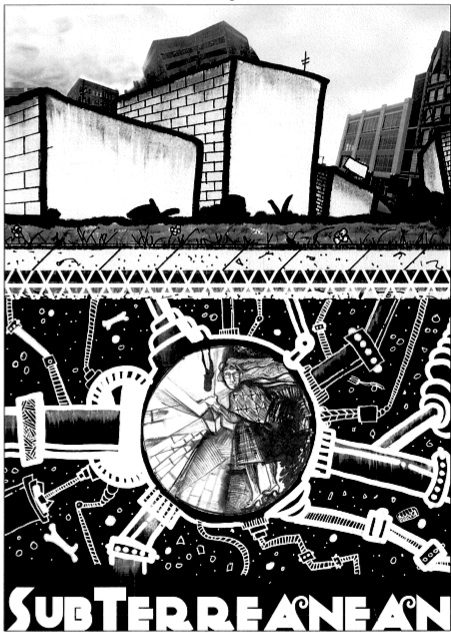
My own main yearly artistic project,
seems like another in-between case, helping with Subterreanean – a
localist poetry, art, literature 'zine, put together by volunteers
once a year. The cities other three literary mags are all sponsored
by the English departments of three of the local colleges, and are
given away free at the yearly launch party and sold for tiny amounts
the rest of the year. In a sense they are Public Art literature,
certainly at least the one paid for by the public university is.
Ours likewise is given away at the launch party, and sold for a tiny
amount the rest of the year, but the closest we have to a sponsoring
organization is “th' poetry asylum.” We are neither licit nor
illicit, neither sponsored nor opposed, neither Street Art nor Public
Art, but with ties to both worlds.
There are several other local examples
that seem to me to be in the grey areas between Public Art and Street
Art. Eames Demetrios made an installation, that imitates the style
of public historical plaques, but for a fantastic setting. And the
one in Terre Haute is in a back alley downtown, a location more
natural for Street Art, than Public Art or private art. There are
culinary activities in our town that are neither legal nor illegal,
(such as the milk share we run) or of regularly disputed legality
(such as the perennial fights between the local health dept. and the
Farmer's Market about exactly what the Health dept. has the authority
to forbid and what it cannot, it's odd to think that Candice's relishes might be somewhere between Street Art and Public Art, but I
think it is so). Or the tables and walls at Coffee Grounds, where
generations have added graffiti and carvings with knife and pen, but
the management seems to carefully walk the middle ground of neither
promoting nor removing the graffiti … Or George's Cafe were doodled
place-mats are occasionally taped to the wall, and a quick scan shows
kid art, college student doodling, and art student apprentice-fine art
haphazardly mixed, along with greasy spoon standards and Lebanese
cuisine …
I don't really have a good term for
this hazy middle ground, the best I've come up with so far is
Community Art, but that certainly has problems. And I see why it
hasn't been the focus of much philosophical reflection. Without
sponsorship from public money or real private money or the gallery
system, this style of art is inherently amateur. Without the
edginess of real illicitness, or the population densities of the
deeply urban setting, neither fame nor "subvertising" success are
particularly likely. In essence the territory is a form of
contemporary folk art, except that unlike say quilting, or painting
Warhammer miniatures, part of the point of the art is to be public.
Mag Uighir mentions an argument that yarnbombing isn't really Street Art "the unavailability of its materials within urban areas, the insufficiently destructive or permanent nature of its application, the identity of its practitioners (educated, upper middle class white women), the de facto legality of its practice (low risk of arrest and prosecution), etc." OK, but yarnbombing is at least another great example of what I am
calling Community Art. Just as we could make a distinction between form and content for Street Art or Public Art (probably not a perfect or hard and fast one, but at least a clarifying communication one), we can make a similar distinction for Community Art. Some art is about life in community, that is neither as opposed as street life, nor as supported as public life, and that might take more familiar forms. But some art takes it's form from community life, and might comment on community life or might comment on something else.
Community Art in my sense is at the intersection of amateur Public Art
and low-risk Street Art. It is where we have the bits of art designed for public
consumption, but without money or officialdom as prime motivators. It is motivated instead I suspect by, well a spirit of community, or of wanting our shared spaces to
be enjoyable despite our lackluster means. It is where the middle class and the middle poor meet in an art world between Fine art and
Guerrilla Art, at some visual equivalent of the neighborhood barbecue or local
pizza joint ... It is the open mic nights and community gardens and take-one-leave-one library boxes. All the sorts of things that didn't exist in some towns I've lived in, and existed in spades in other towns I've lived in. Maybe I'm over-glorifying the mundane here, but I think that there really is a space, a weird sort of middle art, between Street Art and Public Art, a sort of moderate subversiveness for which my words fail, but my hopes continually come back to ...
Anyway, that's the idea I'm throwing into this philosophy of art debate, any thought?
Wednesday, March 4, 2015
Meditations on the Life of Gayle Starr
Towards a new Obituary for Gayle Starr
Gayle Starr died sometime around 1969
in rural Montana. She had been working as a waitress. My old
colleague, Heather Branstetter, found the initial report of her death, as a dateless and contextless newspaper clipping in a file,
while doing historical research on rural Idaho, and commented that
today “we would probably write a different narrative for Gayle
Starr’s obituary.” I did a little more digging and found a few
more articles and details of Gayle's life, but still not enough to
give her a proper obituary. Still I keep thinking about her,
guessing about her life, wondering about it, sorta amazed by it.
Gayle was around 50 when she died, and
was born in 1919, although I can find no clue as to where, or who her
family were. However, we do know that Gayle was assigned as male at
birth and given the name Herbert C. Upton. Gayle's upbringing and
youth are unclear too. But by the age of 42, in 1961, Gayle was an
ex-convict who had done time in both the New Mexico and the Michigan
State Prisons on convictions of larceny, forgery, and fraudulent
checks. In 1961, Gayle lived in Flathead County, MT and worked as a
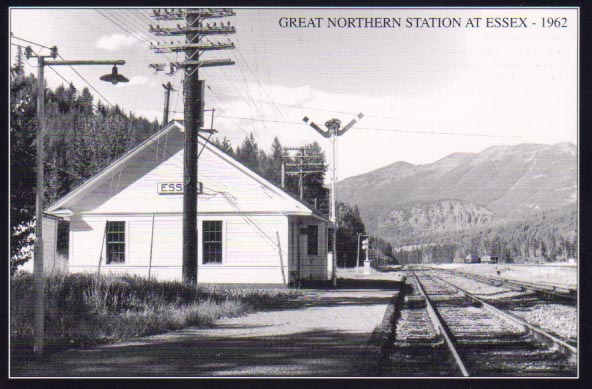
barmaid, in Essex, MT. Essex is a tiny train stop on the edge of Glacier National Park, with few amenities mostly for tourists passing through. Even the county seat of Kalispell isn't exactly big. She was living successfully as a woman for at least 9 months. In
one version of the story, she was arrested by the county Sheriff
“after a tip by an area resident that things were not what they
seemed where 'Gayle Starr' was concerned.” This arrest made it
into the local paper, the Kalispell Daily Inner Lake, and she was
held pending a psychiatric hearing. Another version of the story,
has her being arrested after “area residents filed complaints of
disturbances and threats with the sheriff's office” but the real
problem emerges when Gayle “was growing a beard today in the county
jail while awaiting arraignment for vagrancy and possibly other
charges as yet unspecified.”
She was sent to the State Hospital for
“psychiatric examination.” But the State Hospital “failed to
find” "insanity to warrant commitment,” and further
“previous charges were dropped on the basis of the psychiatrist's
report.” Gayle was released back to Kalispell, a month after
arrest, a free person, albeit one whose conviction record and birth
name had been revealed in the local paper of the county of 30,000ish.
![]() |
| Downtown Kalispell 1974 |
By 1969, Gayle was living in Mineral
County, MT, at the Guy Ghilheri Ranch in Haugan, MT. That county had
only 3000ish people. Gayle had worked at the West End cafe as a
waitress for over a year, at the time of her death. According to
reports Gayle wore women's clothing, used heavy make up, and none of
the locals had a clue that Gayle was given a male name at birth. The
title of Gayle's obituary is “Death Reveals a Masquerade” and it
assumes that Herbert C. Upton was the real person who died, and was
male, and that Gayle Starr was merely the “feminine name” that
“he” used. The file my old friend found the 1969 clipping in was
historical notes marked “Residents of Shoshone Co” (a county in
rural ID, that borders Mineral county, MT and had about 20,000 people
in 1969), so odds are that Gayle lived there too at some point.
| The Silver Bar, Haugan, MT in the 1960s |
Yet Gayle certainly lived publicly
as a woman, for months or years at a time, over the course of at
least 8 years. Despite the name Gayle Starr getting negative
publicity in nearby Kalispell, that was the name that she choose to
use for herself over the following years. That sure sounds like it
was a genuine identity for her, rather than merely an alias of
convenience. The only Herbert C. Upton in the 1950 or 1940 census
(near as I can tell, this could be my limits as a researcher) is a
significantly older fellow living in Mass. So the person named
Herbert C. Upton at birth, probably wasn't going publicly by that
name already by the age of 21. It would have been easy for the
psychiatrist at Montana's state hospital to have Gayle committed,
that he didn't probably means he thought Gayle was a threat to no
one, and also wasn't delusional. Similarly, the Sheriff could
probably have sent Gayle to prison again for forgery. Given that
Gayle's previous convictions included forgery and fraudulent check
writing, it's tempting to guess that Gayle had previously attempted
to live a publicly female life, and got caught and had the book
thrown at her.
The picture that emerges from these
few scattered reports, at least in my imagination, is a person who
struggled their entire adult life to live in an identity and gender
other than the one given them at birth. Someone who paid dearly for
this, doing multiple stints in prison, and then living as an ex-con.
Yet someone who kept being Gayle Starr, whenever she could, in a
culture that definitely did not understand or approve of this.
Living humbly as a barmaid and waitress, in the fading mountain west. Moving from small town to
small town occasionally, probably looking for work, but also trying
to start over again and again when their secret was revealed.
Humble, brave, and relentlessly true to themselves despite real
dangers, that's a mix I can respect.
Musing and Questions on Gayle Starr
1969 was the year that the Stonewall
Riots happened in New York City. The contrast between the queens and
transvestites of the big city, and the wandering rural trans folk is
poignant to me, as a trans person that has never lived in a real
city, or felt a part of trans community.
Evidence suggests that the vast
majority of trans folk choose to move to large cities, and large
cities have been centers of trans culture throughout the 20th
century and still today. Yet, I'm stayin' here in Terre Haute, which
is a bit bigger that Kalispell, MT, but has far more in common with
Kalispell or Wallace ID, than it does with New York, San Francisco,
or Quebec. I often wonder how life is different for rural or small
town trans folk, than it is for big city trans folk. I think there may be advantages to being small town trans as well as disadvantages. It's hard to find kindred spirits. But people are polite to me here, even when their eyes suggest they
disapprove. I suspect the anonymity of the big city takes that away
...
Did Gayle know anyone else in a similar
situation to her? Was Gayle a natural drifter, or did she feel
forced to move? Was there really no one in Mineral Co, who heard
about Gayle's publicity in Flathead Co. a few years earlier? Or did
some folks know and simply not mind, and not want to make trouble for
her?
Why did the state psychiatrist choose
not to have Gayle committed for Transvestism, which was certainly in
the DSM at the time? Why did the Sheriff decide not to press any
charges, including transvestism, or forgery? Were there authority
figures who were covertly trying to create space for trans people to
be themselves in the 60s despite the laws of the time?
Gayle's forgery and fraudulent checking
charges, were those just punishments for trying to live as a woman,
or had she done more than just provide cover for herself? Were
charges like that regularly used to punish trans people? If we
looked back through the fraudulent checking and forgery convictions
would we find lots of cases where the only fraud someone was guilty
of, was trying to be themselves? Were there other techniques that
were used to backdoor punish trans folk, while trying to obscure what
was really going on? Or maybe everyone back then knew that
fraudulent checking sometimes meant kiting checks, and sometimes just
meant trying to open a checking account under a non-birth gender and
getting caught. The mafia famously owned lots of gay bars, including
the Stonewall Inn, was organized crime helping trans folk create fake
IDs, perhaps?
How did Gayle think of herself? Did
she understand herself as a “female impersonator,” as a “queen,”
as a “transvestite?” Several of the newspaper blurbs use the
term “masquerader,” was that a technical term of the time? Would
Gayle have thought of herself in those terms? Christine Jorgensen
was a sensation in 1952, when Gayle was 33. Did Gayle think of
herself as transsexual? Did she dream of surgery? Hormone therapy
became available in the US during the 50s and 60s, but was pretty
tightly controlled. Did Gayle know about that? Did she apply for
it? Was she rejected? There is no mention of hormone pills in any
of the news stories about her.
Who outted Gayle to the Sheriff and
why? What all am I missing from Gayle's story? What would it be
like to be gender non-conforming in your heart in the 20s, the 30s,
the 40s, the 50s, the 60s? I've meet folks from the 70s and 80s and
on. But in the 50s, even open minded experts like Kinsey or Benjamin
were barely wrapping their head around transgenderism. Did the queer
folk in the streets, or drifting from town to town, have a better
understanding of their own situation from up close? Or were they
lost, trying to make sense of themselves with old categories that
barely fit? Did Gayle have experiences that haven't even been hinted
at in the few articles I've found? What did she do during WWII, for
example? She'd have been 22 or 23 in 1942 when the US entered the
war, but perhaps she was already living as a female by then. Did she
have long term relationships during her life? Kids? How did she
relate with her family?
There are so many things I don't know
about Gayle Starr and her life, and she's probably not my kin or
anything, but I keep coming back and musing about her life, and how
people adapt to their times ... The Chevalier D'Eon is just a storybook character to me, but Gayle Starr seems like a person I can almost but not quite relate to, like a great-aunt. Someone from before Stonewall, but after Jorgensen. Everyone else has been thinking about Ferguson and Selma recently, and I certainly see why, but I keep drifting back to thinking about this waitress from Montana I never met ...
Wednesday, February 25, 2015
Fictive Desires vs Imaginary Desires
OK, here is a fun set of philosophical
puzzles, courtesy of current philosophers like Doggett, Egan and Kind
… English is pretty comfortable talking about perception-like
imaginings (imagine a sunset), or belief-like imaginings (imagine
that John Steward is going to run for president in 2016), but are
there desire-like imaginings? If so, what would they be like? What
role would they play? Is there a natural way to talk about them?
Doggett and Egan call them “i-desires” and admit that English
doesn't usually talk this way. Kind asks if there are any other
natural languages that do talk about desire-like imaginings.
I for my part, have had several
reactions here, and I'm sorta still processing them, but hopefully
this blog post will be a little less confused about it, than my chats
and emails so far, but not all the way to a scholarly article on it
or anything. One of the reasons that desire-like imaginings would be
handy if they existed, is that could serve explanatory roles parallel
to actual desires in a variety of cases where there seems to be no
parallel actual desire. So one of Kind's examples goes like this.
“A desire-like imagining is meant to be "a conative state that stands to desire as imagining stands to belief" (Doggett and Egan). The standard case of desire-like imagining is the conative attitude we take towards a fictional character -- as when I [want] Tony Soprano to get away from the cops. I don't believe that Tony Soprano is running from the cops; I (belief like) imagine it. And likewise, I don't want Tony Soprano to get away from the cops, I desire-like-imagine it.”
Or for
Egan
“So for example, believing that the Packers are about to blow their lead in the 4th quarter of the NFC championship game might make me nervous. But not just all by itself. It's got to team up with a desire - for example, the desire that the Packers go to the Super Bowl. (That's why when I believe the Packers are going to blow the lead, I get nervous, and when Ned Markosian believes the Packers are going to blow the lead, he gets excited.) Sometimes, when I imagine stuff, I get that same kind of affective response. For example, when I imagine that Tony Soprano is in danger of getting caught by the feds, I get nervous. How come? If we think it's the same model, we'll want some state that plays the same kind of role in teaming up with my imagining that Tony is in danger to produce my nervousness that my desire that the Packers win played in teaming up with my belief that they were going to blow the lead. Tyler and I don't think we can count on there being a for-real desire around to play the role in all the cases where we get the affective responses. (I don't have the for-real desire about mobsters evading capture. I don't have the for-real desire about the content of the fiction not including Tony's capture. No other candidates seem to do better.) So we think there needs to be a state that stands to imagination as desire stands to belief.”
So the first thing I want to argue is
that distinction we are looking for in these examples is the
difference between a for-real-desire and a fictive-desire, not the
difference between a for-real-desire and an imaginary-desire, and
this is traditionally talked about in terms of “diegetic layers.”
But maybe we'll be able to find other cases where the perception vs
imagination distinction is a better analogy.
In some genres, such as theatre,
almost all the fictional action is perceptual rather than imaginary.
In stage drama much may be intentionally left off-scene, and to the
imagination, and the special effects or lighting or such may be
unrealistic enough to require imaginary re-editing. But in, say, a
professional wrestling match, or a drag show, the fictional layer may
be entirely embodied, and the imagination may have almost no role to
play in making sense of the fictional context. It's possible to have
stories within stories, with multiple fictional diegetic layers, as
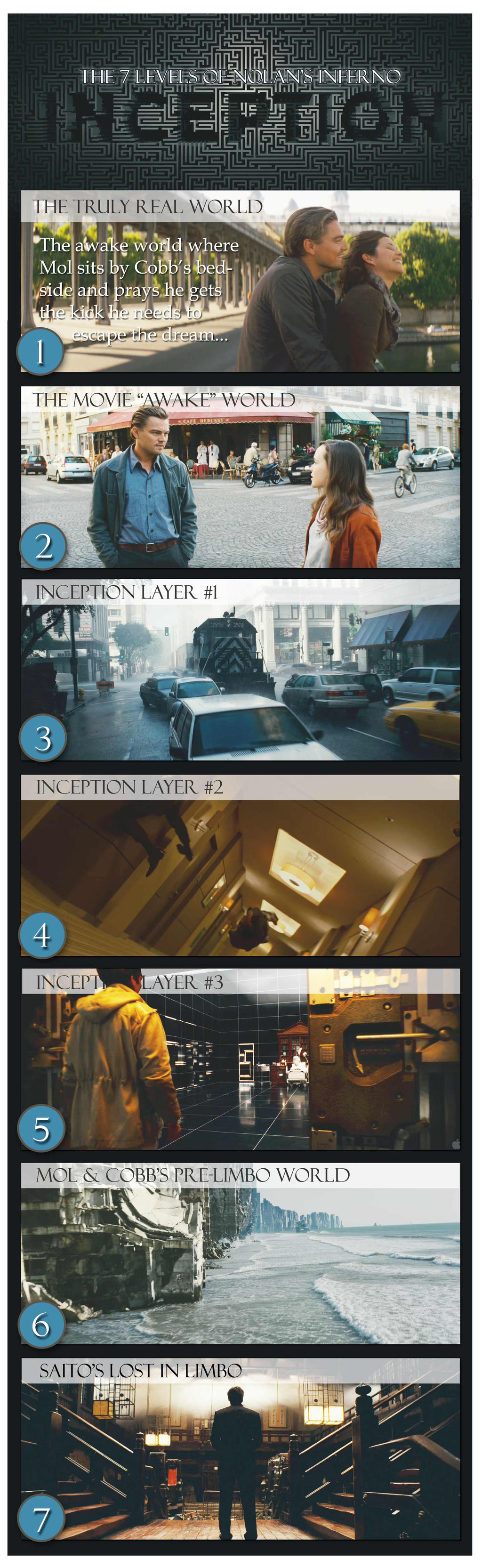
in Hamlet of 1001 Arabian nights. The movie Inception has six distinct fictional diegetic layers to keep straight at one point.
It's also possible to have multiple non-fictional diegetic layers, as
in video games or role-playing games. This can all get pretty
complex, and is a topic of much discussion among literature and art
theory types, and it's often important to actually doing the art and
crafts sides of movie or video game or theatrical storytelling well.
As the audience “identifies” more strongly with a particular
character, or becomes more fully “immersed” in the fictive
setting, the outer diegetic layers start falling away in our
phenomenological experience of the piece. But a clunky interface
moment, or an intentional reference to the world beyond the diegetic
frame can bring the attention back to the outer layers.
If we are being careful, imagining, pretending, and storytelling, are all slightly different activities, even though in practice they are often mixed together heavily. My account of desires about fictional stories is that I have
for-real desires, but desires which are organized by diegetic layer
by my training in the practice of being an audience member (or even
participant) in the storytelling genre. Contra Egan, I'm saying that
if I'm nervous that the cops are closing in on Tony Soprano (rather
than excited that the cops are closing in on Tony Soprano), that
means that I have a desire that the content of the fiction not
include Tony Soprano's capture, probably because at some level, I
have come to identify with him more than I have with the cops trying
to capture him. (Often because the storyteller has worked to make it
easy for me to identify with Tony, and harder to identify with the
cops pursuing Tony). I probably also have a desire that the
fictional contents be entertaining, internally consistent, and artistically satisfying and
that desire may wind up overriding my desire that Tony not be captured
in the fictional setting.
Organizing the desires involved in
consuming fiction by diegetic layer, has several advantages over
organizing them via analogy to the perception vs imagination
distinction. For one thing it can account better for cases where
juggling 3 or more diegetic layers are important. Similarly it can
account for the learning necessary for navigating diegetic layers in
unfamiliar narrative conventions, or for errors made when the
diegetic structure is complex (as it often is in video games and
roleplaying games). The distinction between perception and
imagination in contrast is usually more transparent, and while there
are perceptual illusions, and hallucinatory border cases, it's
usually pretty hard to confuse a perception like-imagining with an
actual perception, they are just so much less vibrant and full.
(Belief-like imaginings, delusions, and beliefs are much easier to
confuse phenomenologically.) Similarly, the organize-desires-by-diegetic-level strategy does a much better job with fictions that are
highly performative, where imagination is playing little role. On
Jan 15, Triple H, (a WWE “heel”)
My desire that Tony Soprano not get
caught is a intradiegetic desire rather than an extradiegetic desire,
or we could maybe say a fictive desire rather than a non-fictive
desire, but I don't think it's best understood as a desire-like
imagining. As Egan says, he's not convinced we'll have real world
desires for all cases where we get affective response, and my
intuition is similar, but I think fictional cases DO have real world
desires. However, maybe we can find something else that will look
like desire-like imaginings ...
Prof Doofenschmitz, the mad scientist villain of Phineas and Ferb, has at one point a musical number about how he wishes he hated Christmas, but how in fact he is pretty meh about Christmas.
The usual philosophical way of making sense of this situation is in terms of “second order desires” - desires that our desires be different than they are. Classically a junkie or pedaphile may intensely desire that they not desire the things they do in fact desire. The thing is, it seems that part of framing a desire to desire something, or not to desire something, would be framing some kind of conative state about the desired state. Often memory will do the trick. If I remember a time before I was a junkie, I might be able to desire that my desires be like they were back then. But phenomenologically, it certainly seems to me that sometimes the best we can do is “imagine” what it would be like for our desires to be a certain way. Maybe I no longer remember what it is like not to crave heroin all the time. Maybe I've never really hated Christmas, and have to imagine what it would be like to hate Christmas, as part of the process of desiring to hate Christmas. Maybe I'm so depressed that I can no longer desire to go to work, but I can still sorta force myself to go, and do so partly by framing an imaginary desire to go to work, and using that as an imperfect substitute for a genuine desire. Or to move it over to sexual desire, maybe I've read 50 Shades of Grey and find that hot. Maybe I desire that I desire to be beaten, but once I actually try it, it doesn't suit me and I realize that I don't actually desire it. I am in fact not much of a masochist, even though the thought of myself as being a masochist is appealing. My wife asserts, and I'm tempted to agree, that folks can even be in the tense state where the 2nd order desire is still present, even after experience has shown that you just don't have the first order desire.
One of the hallmarks of the
perception vs imagination distinction is the limited nature of
imagination, and it's phenomenological “paleness.” Imagination
is typically less detailed, less robust, and less intense than the
perceptual analogous. It has more “aboutness” in it too. A
perception can be a confusing welter of experiencing that we feel ourselves having
to work to organize into a coherent aboutness structure, but a
perception-like imagining has the aboutness structure more
apparent. This seems to be true of those 2nd order
desires that we have to frame via imagination (rather than memory, or
full actual presence). My i-desires in this sense are dimmer,
more tentative, less detailed. If I later feel the parallel
actual-desire it may not be that much like I'd imagined it.
Maybe there are other cases besides some 2nd order desires, where we have to imagine desires that we don't actually feel. In empathy, maybe I partially imagine what it is like to desire a heroin fix above all other things, when I am trying to understand the behavior of junkies, even though I don't have the second order desire to desire that I desired heroin above all other things. Indeed, these constructs in philosophy of mind are sometimes called pretend-desires, or off-line desires, and it's been suggested before, by Currie, that pretend-desires are the same thing as i-desires. Again pretending, imagining, and storytelling are closely related and intermixed, but not really the same activities. Also it's easy to make this kind of imagining sound like a belief-like imagining instead, perhaps I'm actually imagining a world where it was true that I desired heroin above all things. Phenomenological though, it seems to me that I can do both, and that they are distinct. I can belief-like imagine a world or situation where I have this desire as one of the facts of that world/situation. I could then write a fiction, or daydream about it. But trying to desire-like imagine that I crave heroin above all things feels possible a but like different project. Similarly, I see why people would think that in the case of fiction we are imagining desires that we don't really feel. It's just that I think part of how “involvement” or “immersion” in fiction works, is that we start to genuinely feel desires about the fictional context rather than just imagining how the fictional characters feel about their own fictional context. That's it! When I “empathize” with Tony Soprano, I may imagine what it is like for him to desire not to get caught (especially if the pacing is slow and introspective enough), and that may be a desire-like imagining, but because I am involved with the story myself, (especially if the pacing is more griping), I also have an intradiegetic desire on my own part that Tony Soprano not get caught within his fictional setting, and that's what accounts for my nervousness.
So in conclusion, like Egan and
Doggett, I'm optimistic that there are such things as
desire-like imaginings, and that they have some philosophically
explanatory roles to play in some cases (although how distinct they are from more familiar kinds of mental states I'm less convinced of). Like them I suspect there
isn't a good existing term in English for them, so i-desires seems as
good as any. I'm not aware of any foreign languages with clear terms
for i-desires. However, I think i-desires, are importantly different
from fictive desires. Fictions aren't always imaginary, and are
often partly imaginary and partly perceptual. The philosophical
explanations we want for most fictional contexts can be done more
elegantly with “real-world” desires aimed at fictional contexts
and organized along diegetic layer lines. (We really need a term for
desires that aren't i-desires, maybe a-desires?). But other cases, like
empathy, or 2nd order desires where memory or presence is
insufficient, might be much closer phenomenologically to "desire-like
imaginings."
For more info see
Amy Kind - especially The Puzzle of Imaginative Desire," Australasian Journal of Philosophy 89: 421-439 (2011) -
Andy Egan - especially “How We Feel about Terrible, Non-Existent Mafiosi” (with Tyler Doggett) Philosophy and Phenomenological Research
Alan Fine's old sociology book Shared
Fantasy: Role Playing Games As Social Worlds, University of Chicago
Press (Chicago, IL), 1983.
(and since I haven't been in academia a while I need to read most of these too ...)
Thursday, February 12, 2015
Skepticism and Hope
When I was a professional philosopher
I was quite taken by Skepticism. One of the three main sources of my
dissertation was the ancient Greek Skeptic, Sextus Empiricus.
Zhuangzi, who I talked about last week, was among other things a
skeptic. Sometimes today we use the word skepticism for people who
disbelieve in God or ghosts or conspiracy theories or global warming
or whatever. But the older use of the term is for people who don't
have a belief yet one way or the the other, who are open, literally
in Greek it means something like still-investigating. I thought,
(and still think) of skepticism as an epistemic virtue, it's part of
being a good knower, knowing what we can know, and knowing that there
are limits to what we can know, to how certain we can be. It's
related to honesty, it's about being honest about the limits of our
evidence, about admitting when we are partly guessing, when we are
proceeding “as if” something were true, but we know we aren't
sure and we might be wrong. It's being humble about our powers to
know.
But in my own life as someone
struggling with suicide for years, and someone coming out to
themselves and then others as trans, and as someone who talks to
suicidal trans people regularly now, I'm more and more thinking of
Skepticism as a moral virtue too, as something related to hope as
well as related to honesty, or humility or being a good knower.
When I was suicidal, I “knew” that
I was worthless, that my life did more harm than good to the world at
large, that the world would be better off without me, that I would
never again be of value, that my potential was all used up, spent on
a gamble that didn't pay off. My heart told me those things over and
over, and my brain believed them. But in my better moments, another
part of my heart and brain fought against those certainties,
balancing that argument out with arguments on the opposite side, and
resting at some uncertainty, some suspension of beliefs, some
irresolution. I couldn't see how I could ever be valuable, or happy
again, but I had to admit that I didn't know the future, that my
predictions had been wrong before, that I couldn't really be as
certain as I was pretending to be. Maybe my future would suck,
probably, but I couldn't really be certain. Maybe something will
happen that you can't imagine now. Maybe, your situation will change
only a little, but your mentality towards your situation will
transform. Maybe you're wrong about some assumption somewhere in
your train of reasoning, in your train of feeling. It wasn't hope
exactly. Or at least it wasn't the sort of thing I've often seen
portrayed as hope. It wasn't blowing sunshine up my ass, and it
wasn't about positivity. It was a different kind of negativity. I'm
limited and weak enough, that I cannot be sure of the dark certainties
that I feel so sure of. It wasn't about having a positive attitude,
it was about openness to possibilities I couldn't really imagine.
And, of course, for me, this worked.
Your mileage may vary. I argued myself out of suicide time and time
again, and I got slowly better. Eventually I discovered (literally
dis-covering) that I had been repressing my gender issues, and that
being more open about them to myself and eventually others was vastly
more comfortable. I became happy, and in ways, that I literally
failed to imagine when I was at my worst. And again, giving up an
assumption that I thought I knew (that I was male), was a key part of
the psychological process for me.
One of the trans people I talked to
today was very near the end of her rope. Obviously, I don't want to
disrespect her privacy by saying much about her, but it's fair to say
she'd had a surprisingly rough couple of years. She'd heard most of
the lines of thought on suicide before, from friends, family, or
therapists. I certainly wasn't trying to argue with her in anything
like the philosophical sense, and I certainly didn't want to present
false hope. But one of the things I said to her has stuck with me
today. I said “Two years ago, could you have imagined that you
would be where you are now?” And she was very much, no way, not at
all, the things that have happened to me I couldn't have believed or
imagined until they happened. “Ok, then realize that two years
from now, you could be happy again, somehow. I don't know how, and
I'm not saying it's certain, or easy. Just that it's possible. It
feels like there are no possibilities anymore, for you, I know. But
we just don't know the future.” Sometimes life surprises us. It
can be terrible, horrible surprises. But it can be slow, wonderful,
healing surprises too. People that become disabled through injury or disease, sometimes find that after a hard period where everything is very difficult, they actually get to a point where they are happier than they were before the injury, whereas people who win the lottery often find that after an initial period of increased happiness, they wind up less happy than before the event. Happiness as it plays out in actual human lives is complex and often mysterious or paradoxical. You just don't know how you will be two years from now, or five or whatever, if you can survive that long. If you have faith, well, that's one way to
spin it. And the theological virtue of faith is the traditional
precursor to hope, and then, love in the Christian tradition. But
doubt, skepticism, those are ways to spin it too. We just can't
really know that things are as hopeless as we can think we know they
are. Skepticism, as a purely epistemic virtue, preaches
non-hopelessness as a moral virtue. It isn't quite the same thing as
actual hope, I'll admit. But it is a kind of substitute for hope
when hope is hard to find.
If it all seems meaningless or
pointless, well, OK, it seems that way to you, fair enough. But you
can't really KNOW that it is meaningless or pointless. Maybe the
meaning will emerge later. Or maybe it is meaningless after all.
But proper skepticism can pry open the space for the possibility of
meaning, the possibility of hope, in a heart or mind that is all but
closed off to these possibilities.
That is it, that is my philosophical
plea, leave a little space in your heart and mind for possibilities
that you can't really comprehend, even hopeful happy ones.
Friday, February 6, 2015
Zhuangzi and my Gender Identity
I often turn to ancient Chinese
philosophy to try to make sense of things. It's odd for a white,
Midwesterner who doesn't speak Chinese, I know, but it is true. (In fairness, I use Greeks, and Frenchmen, and old professors too). Here's a classic example of me turning to the Ancient Chinese thinkers. So yesterday, I was thinking about
Zhuangzi's most famous parable (he's an ancient Daoist I like, whose
writing style involved lots of bizarre parables). In his “butterfly
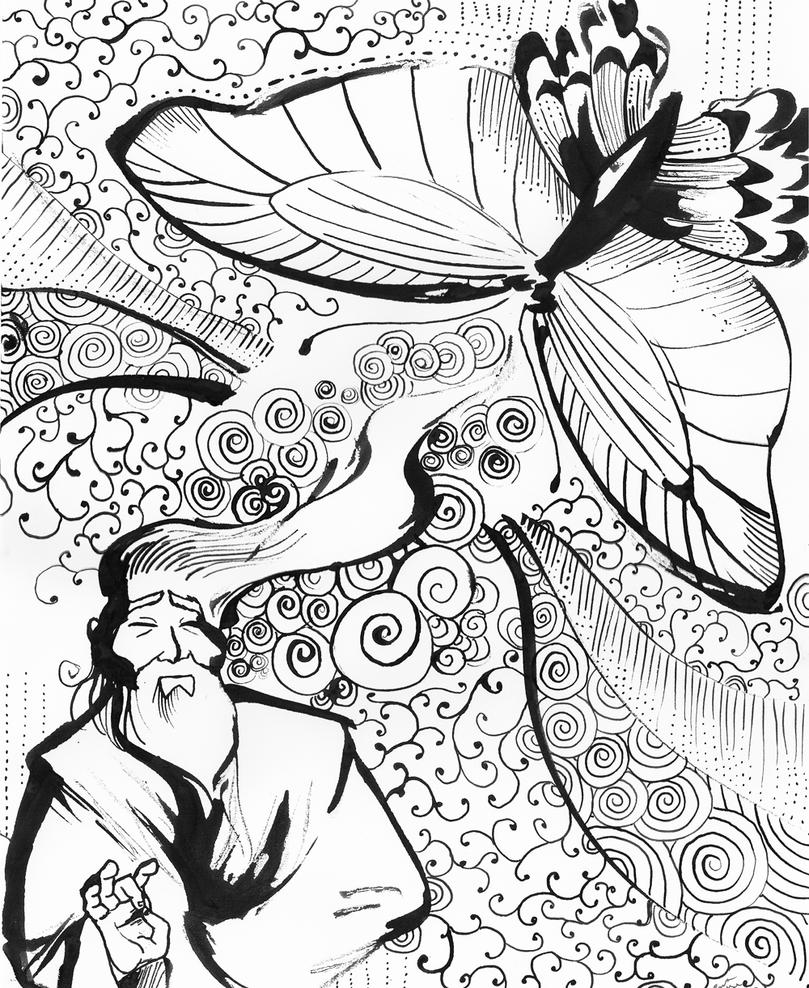
dream,” Zhuangzi dreams he is a butterfly, and on waking is
uncertain whether he “really is” Zhuangzi who dreamed he was a
butterfly, or “really is” a butterfly, who is currently dreaming
that he is Zhuangzi. So let's switch things up a bit, but still
basically plagiarize Zhuangzi ...
“On many occasions, I, Dr. Morton, dreamt I was a woman, living my life as a woman. I was conscious only of my happiness as a woman, unaware that I was male. And soon I awaked, and there I was, male. Then later, I realized that I did not know whether I was a man dreaming I was a woman, or a woman dreaming I was a man. Between male self and female self there was such a distinction. This is called the transformation of things.”
Now first note, at the level of
ontology, this is not all all how we usually use the notion of
transformation. No physical thing has changed here, rather we have
an uncertainty of perspectives. We are shifting between two
different interpretations of self, and in a sense between two whole
worlds, rather than watching a change within one
perspective or interpretation or world. It is that one's assumptions
have come unmoored, and things that previously seemed impossible, or
not even thinkable enough to bother rejecting as impossible, suddenly
seem possible. I have an old argument about free will somewhere that
works just like this. But my early bits gender transition fit this
picture well too. I “knew” that I was male (albeit barely so),
but there were all these opposing bits of data that I just wouldn't
or couldn't take seriously, or frame into an opposing account. And
then, I framed the account, and the “knowing” dropped away, and
suddenly things had been transformed, because I stood between two
accounts, that seemed so distinct, and yet could not both be so.
Maybe I was a man who routinely dreamed of being a woman, or maybe I
was not a man, but routinely worked to convince myself that I was.
How would one go about deciding an issue like that, once it has
become plausible enough to be entertained? How do you know you
aren't a butterfly dreaming that you are a human? Well, obviously,
most people prevent this worry by never really allowing it as a
possibility worth serious consideration in the first place. But once
you do allow it, what then? Similarly, for me, for so long, I just
refused to entertain the possibility, but once I had, I had no
further defenses … And once the two possibilities, I'm a man who
dreams regularly of being a woman vs I'm a non-man regularly working
to pretend to myself that I'm a man – stood together epistemically
roughly equal, I quickly knew which I wanted to be true ...
But that is not really the main thrust
of Zhaungzi's thought on the matter, even in that chapter, book 2 of
Zhuangzi, entitled “The Evening Out Of All Things.” He makes a
lot of points about epistemology, and logic, and mysticism there.
But one reflects where I wound up on the gender stuff with a couple more years of work and reflection. This is a passage I've come back to, many
times over the years. I've recently re-read at least 10 different
translations of it, here is my own translation (heavily dependent on
Sarah Snyder's translation, and careful word by word 'trot' and analysis, in "Science of Myself", but also many other translations and my own opinions and
understandings.)
“There is no being that is not 'that.' There is no being that is not 'this.' From 'that' standpoint we cannot see, but from the standpoint of knowing oneself, one can know. Therefore it is said 'that' comes from 'this,' and 'this' comes from 'that' – which means 'that' and 'this' gives birth to one another. And so with life then death, and death then life. And so with possible then impossible, and impossible then possible. 'This' causes what is uncaused, and what is uncaused causes 'this.' Thus, by means of the sage shedding the light of heaven, 'this' is not the cause, and also is the cause. 'This' is also 'that,' and 'that' is also 'this.' 'That' is also one that 'this' is not, 'this' is also one that 'that' is not. Is the result that 'that' and 'this' are in the same place? Really? Is the result that 'that' and 'this” are not in the same place? Really? When 'this' and 'that' are not incautiously taken as opposites, this is called the pivot of the Dao. At the pivot of the Dao, only then do we attain the center of the ring, where one is not impoverished by what must be so. 'This' also does not exhaust the whole, 'not' also does not exhaust the whole. Consequently, we do not use a limited perspective when we seek to shed light on a topic."
There is an epistemic/mystical place,
where traditional opposites no longer stand in opposition. And this
is different from the moment of transformation in opposition (as in
the first passage), or from an opposition where the tension is being
held and used for some useful purpose (as in Heraclitus' notion of
opposing coherence). Rather yes and no, no longer “stand against
each other,” they seem complementary, or aspects of a whole. It's
also not that 'this' and 'that' merge, or lose all distinction, or
disappear into a mystical Monism. Rather the distinction between
'this' and 'that' ceases to be a source of “exhaustion” or
“impoverishment,”- the situation is “rich” enough to allow
different and distinct accounts to have space to be. In gender, my
male-self and female-self do not merge fully, or stand in some
transcendent unity - but rather both stand together as different and
distinct as they are united or blurred - but as elements of a vaster
richness, elements in a coincidentia oppositorum. Nor am I holding
the two under tension to use the power of the frission, the two stand
distinct/non-distinct as they are testifying to the case, rather than
working as an engine of becoming.
So I say genderqueer and androgyne and
non-binary, rather than male or female. And I don't mean epicene as
in unisex, and I don't mean not-any-of-either-male-or-female, and I
don't mean actively alternating, or paradoxically-fused, or a simple
unity of the two, or transcending the categories of male and female
entirely. I mean sitting in a wide lavish ring of wealthy selfness,
where Brian and Patricia are present, and no one account is vast
enough to account for both together, but I say “BP” as a symbol
of this being-together-within-myself. I mean Anekantavada in Daoist drag, dancing to some crazy Heideggerian euro-pop or something.
And so I remain, as I long have been, a
connoisseur of many extremely fine grades of beyond-binaryness.
Subscribe to:
Posts (Atom)