Tuesday, April 14, 2015
Some Folk From The Trans 100 2015 Class That Have Touched Me
This summary is not available. Please
click here to view the post.

Monday, April 13, 2015
The Value of Not Knowing and Not Doing
| It is also not Being ... |
So one of my philosopher friends
posted this quote by Adrian Johnston (who I don't know), and it provoked quite the discussion, enough that I felt I ought to spell out my thoughts more clearly on my own blog.
“Like the Romantics and Pietists before them, numerous post-idealists in the nineteenth and twentieth centuries end up promoting a facile mysticism whose basic underlying logic is difficult to distinguish from that of negative theology. The unchanging skeletal template is this: There is a given “x;” This “x” cannot be rationally and discursively captured at the level of any categories, concepts, predicates, properties, etc.; Yet, nevertheless, the only true task of authentic thought is to circle endlessly around this sacred void of ineffability, repeating ad infinitum (and ad nauseum) the gesture of grasping at the purportedly ungraspable. The names of this empty “x” vary while the pattern stays constant: Will, Life, Power, Temporality, Being, Other, Flesh, Difference, Trauma, and so on (up to even certain pseudo-Lacanian versions of the Real). Not only is this boringly predictable negative theological cookie cutter an all-too-easily grasped conceptual scheme of its own—even if one were totally to concede the truth of one or more of these ineffabilities as they are held up by their numerous enthusiastic advocates, there is so much more of greater interest and urgency for thinking to do than to remain absorbed in the sedentary meditative exercise of doing nothing but fixedly staring into a dark abyss.”
Now Johnson is published and I am not,
and he is engaging in a longer polemic for philosophical materialism,
which doesn't particularly tempt me. But I am definitely one of the
“enthusiastic advocates” “of these ineffabilities” that is
being sneered at here, and several of the other philosophers in the
discussion expressed similar disdain for ineffabilism, calling it a
“pet hate” or not to be confused with “real work.” My own
stance is that Johnston is more or less right in this passage about the post-idealist pattern, but that his tone
leaves a lot to be desired. Some people thrive on chasing after
doing and thinking that feels urgent to them, and some people thrive
on sedentary meditative exercises that involve a lot of staring into
a dark abyss. Philosophy has room and roles for both types, and most
lives should probably have at least a little of each style in them.
So I want to do a little bit of a discussion and defense of the value
of negative theological approaches, of contemplation, of staring into
the dark abyss, on not-knowing and not-doing, as opposed to more
positive philosophy approaches, activities, theory-building and
system building, striving to know and do.
At the most basic level, theory removal clears space for new theories to emerge. My wife had a
great analogy. Before she cooks, she clears away the stuff on the
counter so she has space to set up what she's doing, so she can see
what's what. Skepticism helps clear away weaker theories, but
contemplation can help clear away theories that might be fine in some
contexts but aren't necessarily helpful or relevant to this
particular task. When we clear the counter before cooking, some
things get thrown away, some things get composted, but some things go
into the wash for later re-use. But not-knowing, starting over as
much as possible from emptiness or openness, rather than cluttered
pre-conception helps us to begin-knowing, instead of always being
stuck in continuing-our-pre-knowings. We “clear away” our
pre-conceptions of Being or Difference, in part to begin to strive to
form more genuine conceptions of Being or Difference. Perhaps in a
sense the negative theology moment of “clearing away” IS more
boring than the positive theory-building moment of “cooking” but
they are properly allies in joint project.
Even if we are thinking more of
personal life examples than philosophical theory-building, the
contemplative work seems to help with being able to cultivate a
detached observation of our own behaviors or patterns in our life
that allows us to then begin addressing them productively. It is
especially helpful when ego and psychological defenses would
otherwise interfere with the process. When I think about my eating
habits, or why I'm always behind in housework, or why I shy away from
certain topics in conversation that seem like I'd be interested in
them - a step of negative philosophy, of clearing away old theories,
or letting-things-happen-without-yet-building-theories-about-them, or
refraining from judgment or conclusion, is often key to getting past
places I've been blocked, especially if I've been block their many
times before. When knowing doesn't work, sometimes
refraining-from-knowing does. When doing doesn't work, sometimes
letting-happen does.
If contemplation taken to the extreme
looks like facile mysticism, lazy, depressing accomplishment of
nothing, then active thinking and doing taken to the extreme looks
like mental busywork, the perfection of anxiety, a spasm of ambition
thrown upon a meaningless canvas. Both are caricatures. But people
need a balance of work and rest, of stress and relief, of theory and
mystery. There are plenty of lives that are out of balance and need
more of one side or the other than they are actually managing to get.
I ain't here to promote a “facile” mysticism, but I know plenty
of Americans who sure seem to me to need more mysticism than they are
in fact getting, and you start off on the easy stuff before you
tackle the more difficult stuff.
More to the point, I find that my
contemplative, ineffabilist, skeptical, aporeticist work has made me
personally more compassionate than I used to be. I look at someone's
situation, and I admit that I don't really understand what it is like
to be them. I have guesses not answers. It is harder to look down
on people than it used to be. It is easier for me to feel
solidarity. When I identified with particular theories, it was easy
to see others as divided from me by our differences at the theory
level, as opponents, as deluded, as wrong or lesser or others. Now
as I feel uncertain and questioning before wondrous complexity,
others feel like allies before the vastness, even if they use
different words to try to express themselves. I stare into the dark
abyss, and I feel a continuity with countless other folks, full of
many differences, who stare into the dark abyss from time to time
whether they want to or not. Our frailty unites us. Ellen Feder had a complex thought on frailty and dignity that I need to post more about in the next month or two, but for now, it is enough to say that our frailty unites us.
I struggled with arrogance a lot when
I was younger. I was right about so many things, that it was easy to
think I was right much more than I actually was. I knew what was
right and what was wrong, and could be pretty annoying self-righteous
about it. And I knew how the world should be, and had confidence
that humans could make it that way, and were in the process of doing
so. But knowledge is more non-monotonic than I gave it credit for.
We learn new things and they call into question old conclusions that
we thought we knew. Science progresses in part by rejecting past
conclusions. And so does legal reasoning, or artistic work, or
knowing in our daily lives. It was fun when I focused on knowing,
instead of the limits of knowing, but I wasn't as good of a person.
Similarly, I thought I had a lot more power than I actually did.
Both in knowing and doing, I over-estimated myself. I enjoyed using my power and freedom, rather than exploring the limits of my power and freedom. As I worked
on negative philosophies: negative theologies, negative ontologies,
anti-epistemologies, un-logics, a-porias, and so on, I came to have
more appreciation for the give and take and non-static nature of the
limits of knowledge, and for the real, but complicated limits of my own
ability to know and do things. Had I been able to impose my Utopian
dreams on the world, it wouldn't have been as glorious as I once
thought. Many of my ambitions were not just overestimations, they
were misplaced. I am a smart person, and I have been wrong about the
central things in my life more than once. The negative paths humble
us again and again, often unpleasantly. We are wrong more often than
we like to admit. We are often guessing when we pretend at knowing.
We are selfish, or privileged, or fail to understand, or have poorly
thought-out goals. Or a thousand other frailties and limitations.
And the negative philosophies, the philosophies of our limits, help us to overcome our own arrogance.
It's also more than that. It is
frustrating to lives within our limitations. I want soooo many
things for my world, my nation, my state, my community, my family, my
loved ones, myself, that I cannot achieve. I want answers to big
questions that I have not been able to suss out. I want LOTS of
things that I have failed at. And living within those limitation,
those frailties, I find it perennially difficult. But the negative
philosophies are a balm, and constant aide for me. The Pyrrhonists
say that they avoid belief on weighty matters that are not forced
upon them, so as to reach “freedom from trouble” (ataraxia) to
the extent that they can, and moderation in feeling even on feelings
forced upon one. Buddhism, Taoism, Negative Christian Theology,
Pyrrhonism, many other philosophical traditions, even this
post-Idealist stuff Johnston is reacting against, they hope and
sometimes claim to be able to help us to live within our limitations.
I want lots of things. But I no longer think that actively striving
for them is always the best response. Some wants ought to be worked
towards, but some ought to be checked, some let go, some allowed to
happen as they will. Our world is too dialectical, sometimes by
striving we only strengthen the opposition. We are too limited. We
can't achieve all the things we want, and it would turn out horrible
if we could. We need to be held in check, and to hold each other in
check. And we need to find ways to make peace with our limits.
Philosophy of exploring our limits is one classic way to work on
this, and staring contemplatively into the void is another. I was
just talking with a lady who feels that she does not matter, and her
problems don't matter, and her life doesn't matter, because no one can
give her solutions to her fucking medical problem instead of trying
to give her consolations. She is dying, and raging, and flailing at
the stark limits of her power and the power of those who love and
care for her. She is not alone. This is how we are. And we need,
we need the ashen never-enough of consolation … We need to
struggle against our limits, and we need to find ways to be consoled
within our limits.
I'm not trying to belittle knowing and
doing either, or the styles of philosophy that focus on them. Theory
building, system building, trying to do things in the world, these
are sane approaches too. If you want to do, you will never do
enough. If you want to know, you will never know enough. That's OK,
try anyway if you want. In my account, these approaches fail; no
theory is adequate, the truth surpasses all system, the world cannot
be fixed via action. But these strategies and active philosophies
and life-paths of active work, they accomplish other things of value
in the process of trying and failing at their main goals. That is
actually how contemplation and negative philosophies and
un-theorizing work too, they fail to speak of the ineffable they try
and fail to speak about, but accomplish other worthwhile goals in the
midst of their failure.
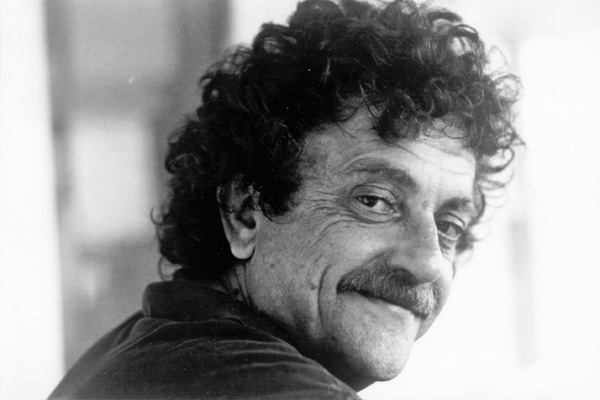
Vonnegut says
“Tiger got to hunt, bird got to fly;
Man got to sit and wonder 'why, why, why?'
Tiger got to sleep, bird got to land;
Man got to tell himself he understand.”
For us, the urge to theorize is very
natural, but so is the urge to step back from theory into questioning
and wondering. Both are parts of philosophizing. My wife is
definitely more active in her approach to life and philosophy, and I
am definitely more contemplative. That's OK. At least that's how things seem to me, if you disagree, tell me about it, maybe we can hash through things together ...
Tuesday, April 7, 2015
Demitheism

In honor of Easter and Passover, I'm
going to revisit a topic I used to be very interested in, but haven't
messed with much in years: demitheism. Demitheism is a word that I
invented years ago to mean “middle positions between theism and
atheism, between 'a God exists' and 'no God exists.'” (Between explicit hard theism and explicit hard atheism - for both
terms there is considerable dispute on how best to define them, and we could be vastly more careful if we we're doing basically back of the napkin philosophical sketches.)
Thus demitheism tends to be compromise positions that answer “does
God exist?” with things like “well sorta, it's complicated.”
You might think that there is little space for compomise here, and
even less motive to try, after all people who believe in God tend to
BELIEVE, and people who reject belief in God, tend to REJECT. But,
in fact, you can build lots of interesting middle positions here, and
historically philosophers have felt pushed towards demitheisms by a
wide variety of concerns and pressures.
The most obvious and widely explored
middle position here is agnosticism, the position that one does not
personally know whether one or more Gods exist or not. OK, fair
enough, I don't have much to say about agnosticism that hasn't been
said before, but I think there are lots more possibilities. To quote
myself 12 years ago:
“But agnosticism is only the beginning of the possible range of middle positions. Perhaps the claim “a God exists” is factually meaningless and therefore in neither true nor false, what A. J. Ayer called theological noncognativism. Perhaps the claim “a God exists” is meaningful, but still manages to be neither-true-nor-false, because Aristotle’s law of excluded middle is an error. Perhaps the claim “a God exists” is both-true-and-false. Perhaps existence is a fuzzy predicate over divinities, and the truth-value of the claim “at least one God exists” is .73. Perhaps God’s existence is underdetermined by the facts, but both God’s existence and non-existence are consistent extensions of the facts. Perhaps the existence of at least one God is a claim that rational agents should assert on some occasions, and retract on other occasions. Perhaps all rational agents should assert this claim at some point in their lives, but should also retract it eventually. Perhaps the appropriate reply to someone who asserts that “a God exists” is not the same on every occasion.”
And as we'll see we could go on. I
came to demitheisms originally as a way of thinking about logical
structure, what are the options for creating meaningful middle
positions? What are the places in our practices of giving and
critiquing accounts where there is space for middle positions like
this? But, over time I've also become interested in the question of
why someone might WANT to take a complicated middle position on a
topic that has more usually been disputed between sharply divided
camps.
Agnostic Demitheism

We may simply not have reflected
enough to reach a solid opinion, or perhaps we have reflected, but
not found any grounds yet that seem particularly decisive to us.
Some agnostics still hope that they will eventually come down on one
side or the other, but are as it were, still undecided. Other
agnostics feel like they have exhausted any strategy they might have
for coming to know the answer (short of death or miracle), and no
longer have much hope of deciding the issue. As a semi-joke we call
a “militant agnostic” someone who takes the position “I don't
know if God exists, and neither do you.” This starts looking more
like an assertive position on the limits of human knowledge, than a
mere admission of one's own lack of knowledge, but I've known folks that believed this way on basically epistemic grounds. It is perfectly
possible to be a demitheist on epistemic grounds. If a God existed
that wanted to hide its existence (perhaps to avoid being blamed for
past decisions), it's hard to imagine how humans would go about
trying to “catch” a hiding God.
Buddhist and Ignostic Demitheisms
-
Gautama Buddha famously supposedly
takes a middle position on the existence of a creator deity. Story
goes, that Buddha is asked if there was a single creator Deity
ultimately responsible for the mess we find ourselves in. And
Buddha is supposedly omniscient at this point (or rather has
all-embracing-knowledge, sarvajnajnana – the difference between
Western and Buddhist conceptions of omniscience is an interesting
topic in it's own right). Buddha replies that if a man was shot by a
poison arrow, he might be anxious on the question of who shot him,
but the more pressing concern is getting the poison arrow out, and
inquiry into who is responsible can wait until later. Similarly,
Buddha argues, we need to escape the bonds of suffering first, and
the question of whether a single creator God exists or not is not
helpful until, at best, after this process has been completed. Buddha
leaves open the possibility that the answer might turn out to be yes,
or no, or it's complicated. Perhaps the process of becoming
enlightened and escaping suffering will dissolve the question
completely. (The story is told in the Cula-Malunkyovada Sutta, as
one of the 14 unanswerable question, and some of the others are
explicitly stated to be destined to dissolve, if I recall right).
Buddha's worry seems not to be about the limits of knowledge, but
about what kind of metaphysical disputes are helpful or non-helpful.
He refuses to answer about whether the universe is infinite or
finite, eternal or not, and whether the self (jiva) is identical to
the body or not. He characterizes answers to these as being like a
net of theories that can entangle one, and refuses to be “drawn
into” the net. This is clearly a different kind of theological
non-assertion, from the agnostic and with a different motivation.
Pyrrhonist Demitheism
A traditional agnostic claims not to
know whether God exists or not, but isn't necessarily actively
cultivating this absence of knowledge. A Pyrrhonist skeptic takes a
more programmatic approach, actively working to cultivate an absence
of knowledge and even belief on weighty topics like whether or not
God exists. Like Buddha, the Pyrrhonist is trying to avoid being
tangled up in nets of theory. The Pyrrhonist skeptic seeks to
balance arguments in favor of God's existence with arguments opposing
God's existence and thereby come to an “epoche” – or suspension
of belief, where balanced between competing considerations one finds
one self in a lack of belief. If you find one side of the argument
or the other to be overly tempting, you spend extra effort exploring
the opposite side to restore balance. If you have insufficient
arguments for one side, you employ one or more of the host of “modes”
or generic arguments about the limits of human knowledge to help
restore balance. The idea here is not at all like modern atheistic
skepticism, but rather an active balancing of position in an attempt
to “cancel out” both and remain at an extremely refined point of
balance. The tradition has a lot of technical language about how to
employ non-assertive “sounds” of skepticism “maybe” “perhaps
it is so” “I suspend judgment” etc. The idea is that by
attaining a very refined mental state of non-judgment, the skeptic
will wind up in a fortunate mental state of having minimized their
troubles as much as they can. For the Pyrrhonist skeptic taking a
middle position between theism and atheism is part of a larger
project of programmatically taking middle positions whenever one is
able to, and this is though to be personally salutary.
Ontological Demitheisms
Even if you in some sense believe in
God, God looks like a tricky limit case for the problem of existence.
You can start from very traditional theism, and find yourself pushed
slowly into saying careful complex, tricksy things about the extent
to which God exists. In traditional Christian theology, for example,
God is Creator, and all other things are Creations. God is radically
unlike all created beings in a wide variety of ways, God has no parts, for example, and doesn't experience change, or indeed “undergo”
or “experience” any thing of any kind. God, as it were, happens to
other things, things don't happen to God. Thomas Aquinas trying to
do hard onto-theology in Book 1 of his Summa Theologica, has to say
things like “God is not a substance” “God is not any sort of
thing” and “God has no properties other than his own nature.”
To the extent that God exists, God exists in a way radically
dissimilar from the way all other things exist. Now there are lots
of classic worries that things like words and intellectual categories
break down when we are trying to apply them to God, and we'll see
more of these in a bit, but words like “being” or “existence”
are especially problematic cases. If God “exists,” then God
“exists” in a way radically different from all other things that
“exist” so why use the word “exist?” Indeed, sometimes
basically theistic theologians will bite that bullet and say that God
is “super-existent” rather than “existent” or is
beyond-being, rather than being a being among beings.

Or we can phrase the problem in
Heideggerese. We thought we knew what we meant by the term “being,”
but now we are perplexed. If Wine's Ignosticism worries that we
spend our whole lives exploring the question of the meaning of the
term “God” and never progress to truly examining whether “God”
exists - a later day Heideggerian can imagine us spending our whole
lives exploring the question of the meaning of being, and never
getting far enough in ontology to really understand being or
existence well enough to truly progress to examining whether God
“exists.” The theist finds that God's ontological situation is
so different from the ontological situation of most beings that they
start getting pushed to demitheism. The atheist ontologist finds
that the nature and ground of being is so problematic, that even if
they reject God, they wind up describing something vaguely similar
playing similar roles.
Ineffabilist Demitheisms
Or perhaps the problem is not so much
God's odd relationship with being, but God's odd relationship with
words or conceptions. If we think that God is “ineffable” or
“beyond all conceptualizations” then in particular “God exists”
is going to fail to be true. Perhaps one thinks that all words fail
to live up to the transcendent God, but some words nonetheless wind
up being aimed at glorifying God.
One way that my favorite old
theologian (Pseudo-Dionysius) puts it, is that each conception we
have or try to frame to describe God, winds up describing something
less than God, which we argue if they exist or not “We make
assertions and denials of what is next to it, but never of it.”
(The Mystical Theology, 1048B). When we say that God is Goodness, or
Being-itself, or the Creator or All, or the big bearded Patriarch in
the Sky, an omniscient-omnipotent-omnibenevolent person or whatever,
these are conceptions which we can attempt to dispute as to whether
they are existent or non-existent, but none of these are God. (At
one point he calls them underhanging logoi.) We are really debating
about the existence or non-existence of our own imperfect and limited
conceptions of God. In a sense, we are back to Ignosticism, but
rather than arguing, we should live our lives as a slow exploration of
or journey towards (or wrestling match with) God, we are worrying
that the mechanism of reference is failing us. For Pseudo-Dionysius,
talking about God, much less disputing about God always winds up
making a strawman argument. Indeed, in this picture, even if I try
to assert that God exists, I fail and wind up only asserting
something like this-conception-of-God-that-I-like-to-use exists.
Apophatic Demitheisms
We can get far more sophisticated in
our accounts of the ineffability of God, and the many theological
strategies that have been used over the ages to partially cope with
this problem. Pseudo-Dionysius in particular has several other
strategies, besides the one I just mentioned, but we are drifting
towards my dissertation here, and I can talk too much about it.
Short version, Pseudo-Dionysius has a methodology for trying to
talking about God to the extent we can, while admitting it is
impossible. This method involves making affirmations and denial in
particular orders for particular reasons. This means that
Pseudo-Dionysius asserts that God exists at one point, and denies
that God exists at another point and says that God is beyond all
assertions and denials at a third. We call it “apophasis” -
“speaking-away” when someone says something, but also tries to
“unsay” it, denying the things they themselves have asserted. In
particular, Pseudo-Dionysius thinks that both the affirmation and
denial that God exist, are useful things to teach people at different
particular stages of their spiritual development. We encourage
people to journey towards God by affirming conceptions a little bit
more noble than what they already understand, and denying conceptions
that they are already ready to outgrow. In a sense, the issue here
is spiritual pedagogy, rather than epistemology, ontology, or
philosophy of language. We assert “'Conception x of God' exists”
and we deny “'Conception x-1 of God' exists.” But later on we
will assert “'conception x+1 of God' exists” and deny “conception
x of God' exists” for basically the same reasons. Eventually we
will even deny of all conceptions of God that they exist, without
affirming of any replacement conception, but only once we are
confident that the student has understood the basic pattern leading
to an apophatic demitheism. Another funny thing about this picture, in a sense theism and atheism are imagined as working together here in a joint project of improving our understanding of God.
Demitheism as a Translation
problem
Another fun form and motive for
Demitheism is when we try to make sense of disparate traditions using
common vocabulary, or use one style of philosophy to try to
understand another. So for example, Samkhya-darsana and Yoga-darsana
are two of the six orthodox (we might say “astika”) schools of
traditional Hindu philosophy – we might say the Rationalist school
and the Yoga school. Both are probably developing in the late BCE
centuries and reach their traditional form in the early CE centuries,
and both are remarkably similar.
But if we ask if the Samkhya-darsana
of ancient Indian “Rationalists” were atheists things get
complicated. For one thing, they are traditionally categorized as an
“astika” (literally “there exists”) school rather than a
“nastika” (“there doesn't exist”) school. In modern Hindi,
astika does mean "theist," and nastika "atheist," and the
classical-medieval six astika schools and four nastika schools do
roughly fit this typology. But is that what “astika” really
meant in classical and medieval times? There is dispute among
medieval and modern scholars about what makes one school astika while
another is nastika … is it taking the Vedas as authoritative
(Manusmirti's 5th cent? position) or perhaps belief in
another world for transmigration (Haribhadra's 9th cent position) or perhaps belief in an atman (Ghurye's 21st cent position) that makes a school astika. Heck, Nagarjuna in the 2nd (ish) century, lists Samkhya as a nastika school, even though most
authorities list it as astika, so there may have been dispute there.
But, the question of whether the
Samkhya-darsana were “atheists” or not gets even thornier. The
Samkhya believed in “prakriti” but not “ishvara.” Indeed,
the Yoga school has different aims and focus, but mostly borrow the
Samkhya metaphysics whole cloth, except to add “ishvara” as one
additional element of the metaphysical picture. Roughly, prakriti is
unified material being. It is a single thing which differentiates
into smaller things. It is an uncaused cause. A prime mover and
first cause, and the source of all material being. It is the ground
of material being. You'll see it translated as “nature” sometimes, but it
is “Nature” in the sense of an ontological prerequisite, not
“nature” as the opposite of “culture” or “artificiality.”
“Ishvara” in contrast, is a word for a personal God, or perhaps
for a Supreme Being, it literally means the ruler of beauty, or maybe
beloved lord. Ishvara often means God conceived as transcendent over
other gods, or the God to which one is most personally devoted, or God conceived as an object of desire. Most
Hindu philosophies have thought of brahman/atman, as combining both
prakriti and ishvara, as being both the first cause of all things,
and the final cause of all things, as being both the source of being
and the most supreme of beings. And that's how Abrahamic conceptions
of God, usually work too, God is both being and lord, both first and
last, both ground and ultimate goal. But the Samkhya school of philosophy
asserts and explores the existence of prakriti, while denying and
arguing against ishvara. And it's not entirely clear how to talk
about this in other languages. Is the Samkhya saying that God
exists, but not as a personal God? Perhaps, it is trying to be what
we might call “Deist” but not “Theist.” Although that way of
talking is problematic since they accept both holy scriptures and
religious rituals. Or maybe the point of this is to accept efficient
causation while denying final causation (although again their causal
theories are complicated and use pretty different terminology than Hellenistic ideas of causation). Or maybe the point is to deny any
kind of moral force or rightness to the way the universe is
unfolding. Or maybe it's frankly “atheist.” Certainly the
Samkhya school gets accused of atheism a lot in modern India. Nor
are there really living Samkhyaist to address the question to, and
the most obvious descendants of the samkhya-darshana, the
yoga-darsana and shaiva siddanta, both gave up the rejection of
ishvara. Samkhya has no problem with Aristotle's God, a first cause
of all things, but it rejects Plato's form of the good. So uhm, are
they theists or atheists? Er … it's not just a problem with
theology, or pedagogy, or philosophy of language, but rather the
contexts and histories are just so different … They never
interacted with the word “theos” one way of the other, but
neither did they ignore it. Rather they talked in their own way, in
their own tradition, and we trying to categorize them, need some
middle position between theism and atheism to do justice to their
belief in prakriti as well as their rejection of ishvara.
Dialethist Demitheism
Dialethism is the position that there
are true contradictions, that sometimes a statement and it's negation
are both true. This directly violated Aristotle's understanding of
the law of non-contradiction, but so be it, such philosophers
disagree with Aristotle, it's not like that's never happened before.
It is possible to motivate Dialetheism from several different cases,
such as the liar's paradox or Russell's paradox. Graham Priest, the
granddaddy of modern Dialethism, argues that dialethia arise at the
boundaries of the expressable in a variety of contexts in formal
semantics. Modern western Dialethists are usually motivated by
issues in logic, rather than say ontology or theology – the sorites
problem or the problem of reasoning from inconsistent case law. But
there usually is an acknowledgement of the role of dialethic
reasoning in Eastern philosophical contexts, the Buddhist logical
system catuskoti, the Jain insistence on anekantavada, the role of
nonduals in zen Buddhism, etc. If we are going to believe in true
contradictions anyway, the question of God's existence seems like a
classic case of a place we might want to assert a dialethia, for any
or several of the reasons already mentioned. If God is importantly
beyond existence, then perhaps we should say of “God exists” that
it is both-true-and-false, or that “God exists” and “God does
not exist” are both true, or however we like to phrase our asserted dialethia.
Summarizationist Demitheism
So my own position on philosophy of
language and truth is an “error theory” in which all claims come
out as being false if we are careful enough. Often I call my
position summarizationism. Statements, properly understood, are
trying to summarize complex situations for some particular
purpose. Statements about the world always wind up being, in fact,
false, but are often, helpful, appropriate summaries, or “close
enough” for their intended purpose. This isn't really even a
failing of language, statements are trying to draw our attention to
some aspects of our complicated world, while eliding and drawing
attention away from others. Rather truth is an overly strong goal,
that misunderstands what we want out of semantics. Our world always
transcends us. The situation is always more complicated than we can
say. Words always fall short of worldly realities. Even these
words. Obviously, like many of the other positions mentioned, I need
to get cozy with self-refutation, but I'm OK with that.
One of the side effects of my general
understanding of language and truth, is that I have to be a
demitheist when it comes to God. “God exists” and “God doesn't
exist” are both false. Both oversimplifications of a case which
transcends us. And for me, God is not unique in this respect. “I
exist” and “I don't exist” or even “The USA exists” and
“The USA doesn't exist” are going to have roughly the same
problem. The situation is too complicated. The USA is a political
fiction, but a political fiction with real bite and a real history.
I myself am more and less than my conceptions of myself. The world
includes beings which need a ground of being, and also which
stand-out from the background on their own (ex-ist, from ex-stare,
“stand away from”). I'm like a Jain asserting anekantavada –
the non-one-sideness of all things. The world just doesn't really
fit into words, and neither do things like God which might be
importantly beyond-the-world in some sense.
Theological Non-Cognativism
Logical Positivists used to argue that
for an empirical claim to have factual meaningfulness it ought to
have testable truth-conditions. Otherwise, we might waste time and
mental energy trying to falsify claims (or better pseudo-claims) that
are not even falsifiable in principle. Because of human limits, we
must establish limits to the claims we are allowed to treat as
factually meaningful, so that science can conduct its business
effectively. Thus, a scientific materialist atheist, may find that
their understanding of the philosophy of science forces them to back
away from strong atheism, and assert instead that the claim “a God
exists” is not factually meaningful, rather than being factually
false. This view came to be known as theological non-cognativism,
the idea that the claim “God exists” is meaningless because it
lacks good testability conditions, rather than it being actually
false, and it had quite a life in Anglo Philosophy from say the 1930s
to 1980s. The theological non-cognativism of AJ Ayers looks like
it's just atheism “phrased differently,” but the theological
non-cognativism of someone like Dewi Phillips looks far more like
someone searching for ways to talk about the weird grounds between
theism and atheism.
Eventually, though many parts of the
logical picture of the Logical Positivists have been beaten up badly
over the course of the twentieth century. Quine argued that the
empirical vs analytic distinction won’t hold up to close scrutiny,
and that there is no strict distinction between observations and
theoretical claims. Popper argued that falsifiability is a
requirement for distinctively scientific claims, but not for all
factual claims. Kuhn argued that claims which are factually
meaningful in one paradigm are often factually incommensurate with
claims from another paradigm. The Logical Positivist rules about
meaningfulness seem to cut against themselves. Heck, Alston and Hick
even used to argue that “eschatological verificationism” could
supply adequate testability conditions to the hypothesis of God's
existence dealing with the problem head on. Nonetheless, even if we
can’t form rigorous criteria for when a claim is or is not
factually meaningful, it might look like the claim “A God exists”
is a particularly tempting candidate for being a non-factually
meaningful claim.
Similarly Wittgenstein has a slightly
different take on how roughly Positivist worries effect religion.
According to him, the sense of the world must lie outside of the
world, and thus outside of the possibility of expressing it via
pictures of the world, and thus outside of the possibility of
expressing it via language (6.4-7). Ethics, aesthetics, God, and the
problems of life, all lie outside of the realm of possible speech,
according to the Tractatus. Thus a Wittgensteinian might be
suspicious of metaphysics of any kind, asserting OR denying the
existence of God. Indeed, Wittgenstein goes one step further, he
says “6.432 How things are in the world is a matter of complete
indifference for what is higher. God does not reveal himself in the
world.” And while this is more extreme than traditional theism,
religious perspectives have often wanted to imagine God as
transcending the world in some sense, so as to distinguish theism
from pantheism. Indeed, if God pre-existed the world and created the
world, it would be odd to think of God as one of the beings IN the
world.
But we habitually use the word
“exists” to refer to beings which are in the world, such as
chairs, or people, or lizards. Indeed, sometimes we even think that
when we assert something’s existence we are asserting that it is
in-the-world. But if so, then the transcendentalist theist’s claim
that “God exists, but not as a being in the world” could be
rendered as “God has some form of being other than existence” or
“No God exists, although some God has a form of being other than
being-in-the-world.” The more we take existence to be a matter of
falling under the scope of an existential quantifier, the more
extra-worldly being starts looking like non-existence.
Consistent Extension Demitheism
Another motivation for demitheism that
I always use to explore, is what I called “consistent extension”
demitheism, although I'm not familiar with anyone who has actually
advanced this one. The idea is to look by analogy at cases like the
axiom of choice, or the parallel postulate, or the relations between
normal modal logics. The Axiom of Choice is formally independent of
Zermelo-Fraekel set theory, ZF, which means that ZFC and ZF~C are both
consistent and non-equivalent extension of ZF. ZF is “neutral”
with respect to the axiom of choice. The axiom of choice is not
already contained within ZF set theory, but both it and it's denial
can be added to ZF set theory yielding coherent accounts of sets.
Similarly the “neutral” geometry can be consistently extended to
Euclidean, hyperbolic, or elliptical geometries. Or the “smallest”
Normal Modal Logic, K, can be consistently extended in a variety of
importantly different and inter-related ways (T, D, S4, S5, etc.).
OK now imagine world W, where a
complete enumeration of the truths of that world, such as they are, (or better yet the deductive closure of W, W*) contained nothing that implied or amounted to either the claim “God
exists” or “God doesn't exist” but that W + “God exists”
and W + “God doesn't exist” were each, non-equivalent consistent
extensions of world W. Such a world would be “neutral” or
“ambiguous” with respect to God's existence. God's existence
would be unprovable in such a world (because it is independent), but
so would the denial of God's existence. The facts of the world would
be capable of being given multiple interpretations, including an
interpretation in which God exists (or more likely several distinct
such interpretations), and at least one interpretation in which God
does not exist. God's existence would be underdetermined by the
facts of the world. No worldly test in world W would disambiguate
God's existence. In a sense, God “hides” from world W. Any
intervention God makes in world W, requires a layer of plausible
deniability, so that it is possible to interpret the facts of the
event as something other than God's intervention, even if it also
possible to interpret the event as God's intervention. W is, in a
sense, a “fideist” world, a world where the facts are
insufficient to falsify disparate faiths as to the interpretation of
the facts.
I don't really want to assert that our
world is a world like W. (In fact I think that truths and facts
don't really work like that, so when you try to enumerate the truths
of our world you get none, so the formalization just doesn't work).
But I still think this is a sort of helpful analogy for imagining
what a world where Fideism worked would be like. The facts always
underdetermine the interpretation of the facts. A world that you can
interpret with or without a God, doesn't really seem that alien to
me.
OK – so obviously each of those
could be a little paperlet or blog post on its own. And I haven't
even tried to tackle say, Hegel, or Heraclitus, or Zhuangzi's
understanding of the “maker of all,” or say Kant's understanding
of the fourth antinomy of reason with respect to the existence of an
absolutely necessary being, and also not. We could find more
philosophical motivations to be pushed to complex middle positions
between theism and atheism if we wanted. My goal here is really just
to give a sketch of a bunch of them to show that many people, for
many reasons, find the terrain between atheism and theism to be
compelling.
Tuesday, March 24, 2015
Announcing Work Slowdowns!

However, it means that I'm going to be writing a lot of philosophy over there rather than over here. I'm not planning to close this blog down, at least short term. I may still throw up a webcomic review or recipe every now and then. But I suspect that from May on, for the rest of 2015, I'll probably post over there a LOT, and over here a very little. I'm hoping to continue to post philosophy, and probably poetry, here for the rest of March and April though. I'll certainly announce it again with far more links, once the other blog actually opens. That concludes our service announcement, carry on folks.
Friday, March 20, 2015
Slacktivism and Szymborska

I've had conversations several times
in the last few weeks, with several people about slacktivism, and the
sense that the bar on political activity has become so low, that the
smallest things seem political, and many seem to channel their
political impulses into the smallest of things. For some this is a
dire sign, the trivializing of the important. The decline of real
activism into the merest shade of symbolic action, the laziest of all
possible protests. For others, this is a sign of political activity
adapting to the tastes and communication styles of a new generation,
of a regeneration of political engagement, where being political is
no longer confined to the halls of money and power, but animates
regular people in their daily lives. For others, the politicization
of all things feels like a stifling interference, where ideas from
the humanities attempt to but their nose into the sciences or
business worlds, or other places where they seem sometimes like
intruders.
I have many mixed feeling myself, but
want to defend some kinds and styles of slacktivism, in some
contexts. Last night, at my open night poetry reading, I read one of
my own fumbling poems on the topic, and another reader I'm slowly
getting to know, replied to me with a poem by Wislawa Szymborska. It
was just exactly right. It has gotten me re-thinking.
But before I get to the poem, I need a
brief detour through “political theology.” American
understanding of political theory usually make sense of the
foundations of the modern state in terms of figures like Locke,
Hobbes, Hume and Smith, even Machiavelli, who turned away from
religion and tried to ground things in talk of contracts. But there
is a strain of political theory, especially in Europe, from Carl
Schmitt to Jurgen Habermas and then to living folks like Giorgio
Agemben, Ernesto Laclau, or Paul Kahn (many of them atheists),
exploring the idea that to quote Schmitt “all significant concepts
of the modern theory of the state are secularized theological
concepts.” In this style of seeing, often called “political
theology,” the foundation of the state is not a prior contract, but
a prior act of sacrifice - and the state itself is not an agreement
among equals constantly being re-negotiated as much as it is a sacred
thing inherited from the past providing a framework within which we attempt
to find meaning for our collective activities.
In this style I thinking, I suspect
that slacktivism looks suspiciously like a political analog of what
in theology is called “cheap grace.” (A term and idea coined by
African-America pastor, Rev. Adam Clayton Powell, popularized by
German theologian Dietrich Bonhoffer in his book The Cost of
Discipleship.) “Cheap grace” is the idea of trying to receive
the blessing of sanctity without having undergone the burdens of
authentic discipleship. Even if the grace is freely given, it seems
somehow a poor or immature response to it to take blessing and move
on with one's life, rather than being deeply transformed by it into
someone trying to “live up to it.” Enjoying the benefits of the
past struggles of political activists who toiled hard and in many
cases “sacrificed” for the current imperfect political regime,
and responding in turn with slacker-activism, can feel intuitively
like “desecrating” past sacrifices or real discipleship/activism.
But being authentically political has
to involve, eventually, integrating politics into one's whole life.
Not just how you vote, but how you spend money, how you talk, how you
act in big things and small. But that means that your political
convictions should manifest somehow in even little, easy, trivial,
dayly things. Which hashtags you use, for instance. As always,
someone who does small things well, but screws up the big ones, is
criticizable, and often a hypocrite, and hypocrisy is especially
loathsome when mixed with arrogance or self-righteousness. But I
have a lot of sympathy with a humble hypocrite, who knows they don't
live up to their highest ideals, yet, and is trying and failing to be
better than they are. And that is true for politics, ethics, or
religion. This is one of the reasons that a culture of calling-outneeds to be replaced in most cases with on of calling-in, where
you criticize well-meaning failures privately rather than publicly and thereby risking alienating potential allies to show off your own
self-righteousness. We want to avoid the hypocrisy of taking the
easy way out, and then letting ourselves off the hook, but we also
want to avoid making the perfect the enemy of the good, too. In this
fascinating analysis of fragmentation on the left I'm a moderate on
the suspicion vs solidarity axis.
If slacktivism is all we do to try to
build intentional bridges between ourself and our world, then that is
pretty pathetic. But if it is one aspect of what we do, that is
another story. Similarly, I'm pretty skeptical of my ability to have
real effects on the decisions of the wealthy and the halls of power.
But I have some power at least over my daily life, and the people I
personally interact with. These minimal interactions - trying to be
polite, friendly, and respectful to people; trying to cut people some
slack; trying to gently encourage thought and growth; trying to help
people see the best in themselves; trying to get my own house in
better order; this is where the personal and political meet, and is
the sphere where I feel the least hopeless. And a lot of that
manifests on the internet, because that is where I do most of my
socializing.
OK Szymborska
“Children of the Age”
We are children of our age,
it's a political age.
All day long, all through the night,
All affairs – yours, ours, theirs -
are political affairs.
Whether you like it or not,
your genes have a political past
your skin, a political cast,
your eyes, a political slant.
Whatever you say reverberates,
Whatever you don't say speaks for
itself.
So either way you're talking politics.
Even when you take to the woods,
you're taking political steps
on political grounds.
Apolitical poems are also political,
| Our political moon |
and above us shines a moon
no longer purely lunar.
To be or not to be, that is the
question.
and though it troubles the digestion
it's a question, as always, of
politics.
To acquire a political meaning
you don't even have to be human.
Raw material will do,
or protein feed, or crude oil,
or a conference table whose shape
was quarrel over for months:
Should we arbitrate life and death
at a round table or a square one.
Meanwhile, people perished,
animals died,
houses burned,
and the fields ran wild
just as in times immemorial
and less political.
-by Wislawa Szymborska, translated by
Stanislaw Baranczak and Clare Cavanagh, 1988
All human affairs, and even many
things beyond the immediately human, are political whether we like it
or not. Who we are personally is political, even in our genes and
our past. We don't have to focus on the political aspect of our
experience all the time, thematizing it. Sometimes we can look at
the sunset or do math or sip tea while watching TV. These things are
political too, it's part of the background of their being, but we
don't always have to focus on it. We DO have to admit it to
ourselves, acknowledge that self and world and others are all linked
in various ways whether we like it or not. Politics may feel intrusive in some domains, but it is already there whether we like it or not, it is just a matter of if we can overcome our self-deception enough to face it squarely from time to time. We do have to find ways
to live our lives within this interlinking. We do have to
acknowledge that people are perishing while we arbitrate life and
death, but that this is not new, or unique to us. That there isn't a
quick fix, or cheap grace or slacktivist solution to the conundrums of interconnection. But slacktivism may well be one part of
navigating this terrain well. I still have good hope that there is
room for ourselves to unfold within this space of interconnection,
well, some of ourselves … sigh.
Tuesday, March 17, 2015
Between Street Art and Public Art - let's call it Community Art maybe?
So I'm no expert on Street Art but one
of the very first ideas in the philosophical reflection on Street Art
is that Street Art and Public Art are not the same thing. There was
recently a conference on the philosophy of Street Art, and a
philosopher I like Christy Mag Uighir has been posting a lot about reflections on Street Art. I'd like to summarize a few of her ideas,
and then add one tentative one of my own - that there seems to be a
real space in my community for art that is in between traditional
Street Art and traditional Public Art.
.JPG/1024px-Mural_de_Keith_Haring_(1).JPG) |
| Mural by Keith Haring in Barcelona |
The idea of taking art out of the
galleries, museums and places of the rich, and into places not
usually associated with art is an old one. Indeed, the high art vs
folk art distinction has always traded on these tensions to some
extent, with plenty of 20th century artists intentionally
playing with the possibilities. Take this basic idea, move it into
urban contexts, add some graffiti, and it starts getting called
Street Art in the 1980s, with artists like Keith Haring, or Jean
Basquiat, or more recently Banksy, becoming classic examples. Street
Art often had strong political, activist tones, often a strong sense
of subversion. The sense that the art was illicit, dangerous to
actually perform, and subject to official opposition and reprisals if
the artist was caught was definitely part of the aesthetic. Themes
of poverty, and racial and sexual minorities have been important
parts of the style since the 80s, when black folk and queer folk
often felt they had no access to more traditional art worlds.
Traditional graffiti is the most iconic form, but there have been
lots of others for decades, stencil art, murals, “lock on” street
sculptures, etc.
 |
| Statue of Max Ehremann, a piece of clear Public Art in Terre Haute |
“Public Art” is an old idea, but
the current phrase has a lot to do with the New Deal policies of the
1930s, and the American experience of publicly funded art since
then. Since the 1970s, “Public Art” has largely been about
getting funding at the local level to spend money on site-specific
sculptures and installations that will be aimed at the public. The
results are often displayed, “on the streets” as it were, but
have official imprimatur, with committees gathering funding and
commissioning artists to create the installations. These are, in a
sense, the modern descendants of the architecture of monuments and
public fountains and such.
At the most basic level, Street Art,
whether visual graffiti art or busking or poetry stenciled in
alleyways is about making art even where and when it is not allowed,
and Public Art is about obtaining sanction and funding, and being
involved in the bureaucracy of site design and zoning and such to
gain legitimate permission to put art somewhere public. Illegality,
or at least some sort of illicitness, is at the heart of the style,
and probably is central to the definition of Street Art, whereas,
some sense of being officially sponsored, is at the heart of the
style, and probably is central to the definition of Public Art. All
well and good, and well explored by thinkers and artists before me,
one more side track, before we get to my claim.
Christy Mag Uidhir makes a distinction between Street Art (form) and Street Art (content).
“Street Art (Form)—Art
in some Street Medium
Works having certain formal,
compositional, material conditions mediated by certain contexts or
relations (spatial, legal, social, cultural, communal, political,
racial, proprietary, self-referential, etc.) necessary for the making
and appreciation of works of that form: e.g., Performance Art,
Conceptual Art, Installation Art, ...Street Art
Street Art (Content)—Art
about the Street
Works having certain contents,
specifically those within the narrow class of contents identified by
reference to, relevance for, comment on those issues, contexts,
relations, and environments considered saliently Street: e.g.,
Political Art, Feminist Art, Religious Art, ...Street Art”
So, for example, Sassafras Lowery's
novel “Roving Pack” about homeless queer and trans teens, or the
anthology she edited “Kicked out” about teens being kicked out of
their homes, are surely examples of Street Art (content), in that
they are manifestly about life on the streets, and all of the dodgy
legality, underclassness, subversion and such that goes with that,
but they are just as surely NOT Street Art (form), in that their
forms are traditional novel, and published anthology of writings,
neither of which are particularly “street.” We could easily
enough make the same distinction with regards to Public Art. The
mosaics by the banks of the Wabash in Fairbanks Park here in Terre
Haute, are clearly Public Art (form), as small scale permanent
installation/monuments on public land, but their content is largely
about local biology. Myke Flaherty's “Excuse Me, Terre Haute” is clearly Public Art (content), it's a song about public life, that
he was trying to get to become the official city song, but he never
succeeded, and the form is pretty standard studio re-mix music.
The thing is, when I try to think of
examples of Street Art and Public Art in my own large town/small city
of Terre Haute, I can think of several clear examples of each, but
lots and lots of examples, that appear to be in between the two
extremes - art that is aimed at the populace at large, but is neither
clearly illegal or illicit, nor clearly sponsored by official
channels.
Take street music. If a street
musician attempts to busk anywhere downtown or on campus, under
normal conditions, day or night, they get hustled away by the cops
and maybe fined (Street Art - form). If they would like to play on
Saturday mornings at the Farmer's Market, they have to schedule ahead
of time with the market mistress, but are allowed (Public art –
form). Similarly, big events downtown that get permits (like the
Blueberry Festival, or Downtown Block Party, or Straussenfest) often
schedule musicians (still Public Art - form). But occasionally, a
busking musician will set up near the entrance to the Baesler's
Supermarket during the day. I've seen at least 4 different ones,
including one I sorta know. The police won't hassle them as long as
they are on Baesler's property rather than the city sidewalk, and
Baesler's itself neither sponsors them, nor asks them to leave as
long as they aren't causing a problem. Their activity is neither
sponsored nor illicit.

Or consider graffiti; Terre Haute has
plenty of graffiti of the tagging variety. And some occasionally
clearly has artistic goals rather than merely being tagging, and so
seems like Street Art. Some of it is clearly local, others cases are on the sides of the railroad cars Terre
 Haute is famous for. Up in 12 points, one night last in Sept
someone graffitied the heck out of the old corner store, except that
it was clearly artistic in style and abstract in form with no clear
message. Well, when the “graffiti buster” task force went to
clear it up, the owner objected and admitted that HE had done it tohis own building claiming it's not graffiti “it's art … I mean
there are some things going on here but if you look down Lafayette
you see empty building after empty building. But I own this building,
it’s my canvas,” - So uhm, is it Street Art when the rightful owner does it to their own building? Surely not. Is it Public Art, when a public task force tries to eliminates it, but then backs off? Surely not. We need some middle category.
Haute is famous for. Up in 12 points, one night last in Sept
someone graffitied the heck out of the old corner store, except that
it was clearly artistic in style and abstract in form with no clear
message. Well, when the “graffiti buster” task force went to
clear it up, the owner objected and admitted that HE had done it tohis own building claiming it's not graffiti “it's art … I mean
there are some things going on here but if you look down Lafayette
you see empty building after empty building. But I own this building,
it’s my canvas,” - So uhm, is it Street Art when the rightful owner does it to their own building? Surely not. Is it Public Art, when a public task force tries to eliminates it, but then backs off? Surely not. We need some middle category.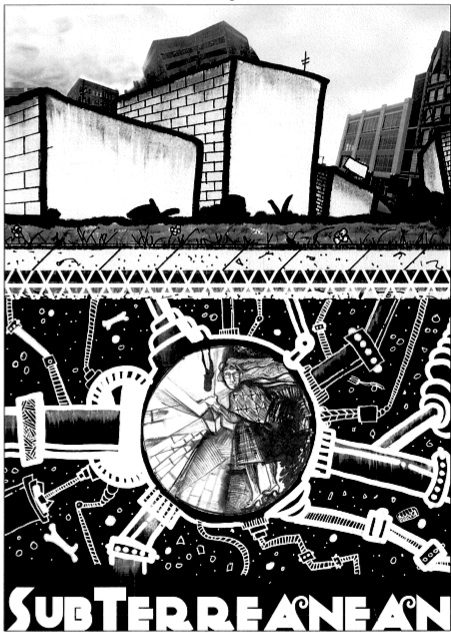
My own main yearly artistic project,
seems like another in-between case, helping with Subterreanean – a
localist poetry, art, literature 'zine, put together by volunteers
once a year. The cities other three literary mags are all sponsored
by the English departments of three of the local colleges, and are
given away free at the yearly launch party and sold for tiny amounts
the rest of the year. In a sense they are Public Art literature,
certainly at least the one paid for by the public university is.
Ours likewise is given away at the launch party, and sold for a tiny
amount the rest of the year, but the closest we have to a sponsoring
organization is “th' poetry asylum.” We are neither licit nor
illicit, neither sponsored nor opposed, neither Street Art nor Public
Art, but with ties to both worlds.
There are several other local examples
that seem to me to be in the grey areas between Public Art and Street
Art. Eames Demetrios made an installation, that imitates the style
of public historical plaques, but for a fantastic setting. And the
one in Terre Haute is in a back alley downtown, a location more
natural for Street Art, than Public Art or private art. There are
culinary activities in our town that are neither legal nor illegal,
(such as the milk share we run) or of regularly disputed legality
(such as the perennial fights between the local health dept. and the
Farmer's Market about exactly what the Health dept. has the authority
to forbid and what it cannot, it's odd to think that Candice's relishes might be somewhere between Street Art and Public Art, but I
think it is so). Or the tables and walls at Coffee Grounds, where
generations have added graffiti and carvings with knife and pen, but
the management seems to carefully walk the middle ground of neither
promoting nor removing the graffiti … Or George's Cafe were doodled
place-mats are occasionally taped to the wall, and a quick scan shows
kid art, college student doodling, and art student apprentice-fine art
haphazardly mixed, along with greasy spoon standards and Lebanese
cuisine …
I don't really have a good term for
this hazy middle ground, the best I've come up with so far is
Community Art, but that certainly has problems. And I see why it
hasn't been the focus of much philosophical reflection. Without
sponsorship from public money or real private money or the gallery
system, this style of art is inherently amateur. Without the
edginess of real illicitness, or the population densities of the
deeply urban setting, neither fame nor "subvertising" success are
particularly likely. In essence the territory is a form of
contemporary folk art, except that unlike say quilting, or painting
Warhammer miniatures, part of the point of the art is to be public.
Mag Uighir mentions an argument that yarnbombing isn't really Street Art "the unavailability of its materials within urban areas, the insufficiently destructive or permanent nature of its application, the identity of its practitioners (educated, upper middle class white women), the de facto legality of its practice (low risk of arrest and prosecution), etc." OK, but yarnbombing is at least another great example of what I am
calling Community Art. Just as we could make a distinction between form and content for Street Art or Public Art (probably not a perfect or hard and fast one, but at least a clarifying communication one), we can make a similar distinction for Community Art. Some art is about life in community, that is neither as opposed as street life, nor as supported as public life, and that might take more familiar forms. But some art takes it's form from community life, and might comment on community life or might comment on something else.
Community Art in my sense is at the intersection of amateur Public Art
and low-risk Street Art. It is where we have the bits of art designed for public
consumption, but without money or officialdom as prime motivators. It is motivated instead I suspect by, well a spirit of community, or of wanting our shared spaces to
be enjoyable despite our lackluster means. It is where the middle class and the middle poor meet in an art world between Fine art and
Guerrilla Art, at some visual equivalent of the neighborhood barbecue or local
pizza joint ... It is the open mic nights and community gardens and take-one-leave-one library boxes. All the sorts of things that didn't exist in some towns I've lived in, and existed in spades in other towns I've lived in. Maybe I'm over-glorifying the mundane here, but I think that there really is a space, a weird sort of middle art, between Street Art and Public Art, a sort of moderate subversiveness for which my words fail, but my hopes continually come back to ...
Anyway, that's the idea I'm throwing into this philosophy of art debate, any thought?
Wednesday, March 4, 2015
Meditations on the Life of Gayle Starr
Towards a new Obituary for Gayle Starr
Gayle Starr died sometime around 1969
in rural Montana. She had been working as a waitress. My old
colleague, Heather Branstetter, found the initial report of her death, as a dateless and contextless newspaper clipping in a file,
while doing historical research on rural Idaho, and commented that
today “we would probably write a different narrative for Gayle
Starr’s obituary.” I did a little more digging and found a few
more articles and details of Gayle's life, but still not enough to
give her a proper obituary. Still I keep thinking about her,
guessing about her life, wondering about it, sorta amazed by it.
Gayle was around 50 when she died, and
was born in 1919, although I can find no clue as to where, or who her
family were. However, we do know that Gayle was assigned as male at
birth and given the name Herbert C. Upton. Gayle's upbringing and
youth are unclear too. But by the age of 42, in 1961, Gayle was an
ex-convict who had done time in both the New Mexico and the Michigan
State Prisons on convictions of larceny, forgery, and fraudulent
checks. In 1961, Gayle lived in Flathead County, MT and worked as a
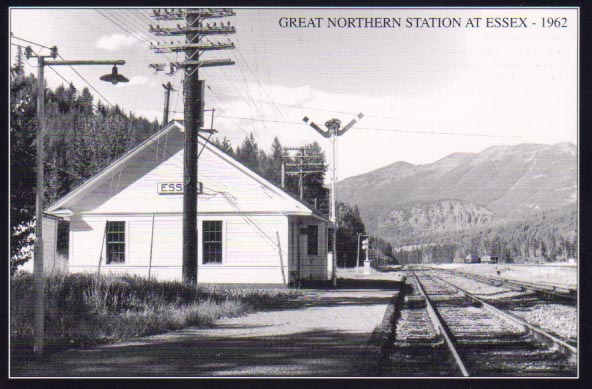
barmaid, in Essex, MT. Essex is a tiny train stop on the edge of Glacier National Park, with few amenities mostly for tourists passing through. Even the county seat of Kalispell isn't exactly big. She was living successfully as a woman for at least 9 months. In
one version of the story, she was arrested by the county Sheriff
“after a tip by an area resident that things were not what they
seemed where 'Gayle Starr' was concerned.” This arrest made it
into the local paper, the Kalispell Daily Inner Lake, and she was
held pending a psychiatric hearing. Another version of the story,
has her being arrested after “area residents filed complaints of
disturbances and threats with the sheriff's office” but the real
problem emerges when Gayle “was growing a beard today in the county
jail while awaiting arraignment for vagrancy and possibly other
charges as yet unspecified.”
She was sent to the State Hospital for
“psychiatric examination.” But the State Hospital “failed to
find” "insanity to warrant commitment,” and further
“previous charges were dropped on the basis of the psychiatrist's
report.” Gayle was released back to Kalispell, a month after
arrest, a free person, albeit one whose conviction record and birth
name had been revealed in the local paper of the county of 30,000ish.
 |
| Downtown Kalispell 1974 |
By 1969, Gayle was living in Mineral
County, MT, at the Guy Ghilheri Ranch in Haugan, MT. That county had
only 3000ish people. Gayle had worked at the West End cafe as a
waitress for over a year, at the time of her death. According to
reports Gayle wore women's clothing, used heavy make up, and none of
the locals had a clue that Gayle was given a male name at birth. The
title of Gayle's obituary is “Death Reveals a Masquerade” and it
assumes that Herbert C. Upton was the real person who died, and was
male, and that Gayle Starr was merely the “feminine name” that
“he” used. The file my old friend found the 1969 clipping in was
historical notes marked “Residents of Shoshone Co” (a county in
rural ID, that borders Mineral county, MT and had about 20,000 people
in 1969), so odds are that Gayle lived there too at some point.
 |
| The Silver Bar, Haugan, MT in the 1960s |
Yet Gayle certainly lived publicly
as a woman, for months or years at a time, over the course of at
least 8 years. Despite the name Gayle Starr getting negative
publicity in nearby Kalispell, that was the name that she choose to
use for herself over the following years. That sure sounds like it
was a genuine identity for her, rather than merely an alias of
convenience. The only Herbert C. Upton in the 1950 or 1940 census
(near as I can tell, this could be my limits as a researcher) is a
significantly older fellow living in Mass. So the person named
Herbert C. Upton at birth, probably wasn't going publicly by that
name already by the age of 21. It would have been easy for the
psychiatrist at Montana's state hospital to have Gayle committed,
that he didn't probably means he thought Gayle was a threat to no
one, and also wasn't delusional. Similarly, the Sheriff could
probably have sent Gayle to prison again for forgery. Given that
Gayle's previous convictions included forgery and fraudulent check
writing, it's tempting to guess that Gayle had previously attempted
to live a publicly female life, and got caught and had the book
thrown at her.
The picture that emerges from these
few scattered reports, at least in my imagination, is a person who
struggled their entire adult life to live in an identity and gender
other than the one given them at birth. Someone who paid dearly for
this, doing multiple stints in prison, and then living as an ex-con.
Yet someone who kept being Gayle Starr, whenever she could, in a
culture that definitely did not understand or approve of this.
Living humbly as a barmaid and waitress, in the fading mountain west. Moving from small town to
small town occasionally, probably looking for work, but also trying
to start over again and again when their secret was revealed.
Humble, brave, and relentlessly true to themselves despite real
dangers, that's a mix I can respect.
Musing and Questions on Gayle Starr
1969 was the year that the Stonewall
Riots happened in New York City. The contrast between the queens and
transvestites of the big city, and the wandering rural trans folk is
poignant to me, as a trans person that has never lived in a real
city, or felt a part of trans community.
Evidence suggests that the vast
majority of trans folk choose to move to large cities, and large
cities have been centers of trans culture throughout the 20th
century and still today. Yet, I'm stayin' here in Terre Haute, which
is a bit bigger that Kalispell, MT, but has far more in common with
Kalispell or Wallace ID, than it does with New York, San Francisco,
or Quebec. I often wonder how life is different for rural or small
town trans folk, than it is for big city trans folk. I think there may be advantages to being small town trans as well as disadvantages. It's hard to find kindred spirits. But people are polite to me here, even when their eyes suggest they
disapprove. I suspect the anonymity of the big city takes that away
...
Did Gayle know anyone else in a similar
situation to her? Was Gayle a natural drifter, or did she feel
forced to move? Was there really no one in Mineral Co, who heard
about Gayle's publicity in Flathead Co. a few years earlier? Or did
some folks know and simply not mind, and not want to make trouble for
her?
Why did the state psychiatrist choose
not to have Gayle committed for Transvestism, which was certainly in
the DSM at the time? Why did the Sheriff decide not to press any
charges, including transvestism, or forgery? Were there authority
figures who were covertly trying to create space for trans people to
be themselves in the 60s despite the laws of the time?
Gayle's forgery and fraudulent checking
charges, were those just punishments for trying to live as a woman,
or had she done more than just provide cover for herself? Were
charges like that regularly used to punish trans people? If we
looked back through the fraudulent checking and forgery convictions
would we find lots of cases where the only fraud someone was guilty
of, was trying to be themselves? Were there other techniques that
were used to backdoor punish trans folk, while trying to obscure what
was really going on? Or maybe everyone back then knew that
fraudulent checking sometimes meant kiting checks, and sometimes just
meant trying to open a checking account under a non-birth gender and
getting caught. The mafia famously owned lots of gay bars, including
the Stonewall Inn, was organized crime helping trans folk create fake
IDs, perhaps?
How did Gayle think of herself? Did
she understand herself as a “female impersonator,” as a “queen,”
as a “transvestite?” Several of the newspaper blurbs use the
term “masquerader,” was that a technical term of the time? Would
Gayle have thought of herself in those terms? Christine Jorgensen
was a sensation in 1952, when Gayle was 33. Did Gayle think of
herself as transsexual? Did she dream of surgery? Hormone therapy
became available in the US during the 50s and 60s, but was pretty
tightly controlled. Did Gayle know about that? Did she apply for
it? Was she rejected? There is no mention of hormone pills in any
of the news stories about her.
Who outted Gayle to the Sheriff and
why? What all am I missing from Gayle's story? What would it be
like to be gender non-conforming in your heart in the 20s, the 30s,
the 40s, the 50s, the 60s? I've meet folks from the 70s and 80s and
on. But in the 50s, even open minded experts like Kinsey or Benjamin
were barely wrapping their head around transgenderism. Did the queer
folk in the streets, or drifting from town to town, have a better
understanding of their own situation from up close? Or were they
lost, trying to make sense of themselves with old categories that
barely fit? Did Gayle have experiences that haven't even been hinted
at in the few articles I've found? What did she do during WWII, for
example? She'd have been 22 or 23 in 1942 when the US entered the
war, but perhaps she was already living as a female by then. Did she
have long term relationships during her life? Kids? How did she
relate with her family?
There are so many things I don't know
about Gayle Starr and her life, and she's probably not my kin or
anything, but I keep coming back and musing about her life, and how
people adapt to their times ... The Chevalier D'Eon is just a storybook character to me, but Gayle Starr seems like a person I can almost but not quite relate to, like a great-aunt. Someone from before Stonewall, but after Jorgensen. Everyone else has been thinking about Ferguson and Selma recently, and I certainly see why, but I keep drifting back to thinking about this waitress from Montana I never met ...
Subscribe to:
Posts (Atom)